
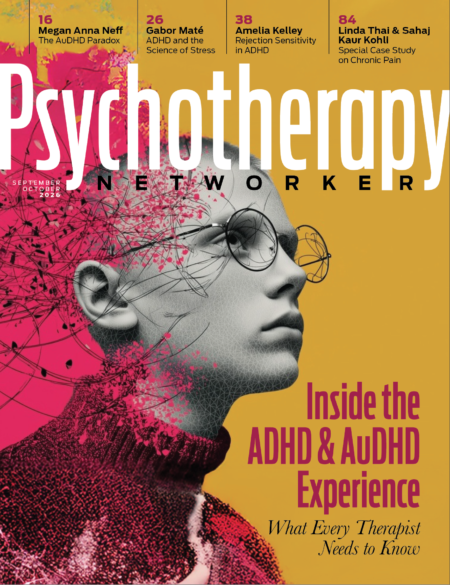

Thirty years ago, when ADHD was the new diagnosis on the clinical block, it fit a very narrow picture: young, impulsive boys who couldn’t seem to stop moving, stop talking, or stop getting in trouble. Back then, those four letters were surrounded by a fog of stigma so thick you could barely see the struggling kid behind the behaviors, much less the desperate parents begging teachers and therapists for help and understanding. But as the number of kids diagnosed with ADHD began to climb, that fog started to lift—and more and more adults got diagnosed too. Then, as tends to happen when our field listens closely to people’s lived experience, the clinical picture of ADHD grew fuller and more nuanced.
We started figuring out how ADHD shows up in girls and women (think: fawning, depression, anxiety), how it runs in families and affects relationships, what the ADHD brain needs to thrive, and how it shifts across the lifespan. Recently, bestselling author Gabor Maté even released an updated edition of his very first book, Scattered Minds: The Origins and Healing of Attention Deficit Disorder, originally published in 1999 shortly after he and his kids were diagnosed with ADHD. In his interview with us, he unpacks what the research says about how stress and our environment affect ADHD, and he responds to the controversy his perspective has stirred among critics.
If you’re still brushing off ADHD as just the latest diagnostic fad—one that doesn’t involve you or your practice—I hope you’ll pause and read this issue anyway. Many of the authors featured in it are ADHD clinicians, who specialize in working with ADHD clients, and their stories opened my eyes to the complexity, intensity, and even trauma of the ADHD experience.
I now see why rejection sensitivity dysphoria, which often co-occurs with ADHD, is not just a crippling neurobiological reaction, but an understandable response to a lifetime of correction, criticism, and negative judgement. I get why, despite the ubiquity of the ADHD diagnosis, many people still get missed and end up carrying around a corrosive self-narrative that they’re broken, lazy, over-reactive, overly sensitive, and careless. I’ve come to understand why experts have argued that, even though it’s not part of the official diagnostic criteria, emotional dysregulation is a core component of ADHD.
And I’ve also come to understand why, as licensed professional counselor and author Nyck Walsh argues, given all the creativity and inherent passion that come with having an ADHD brain, we might consider calling it something else entirely that doesn’t have the words deficit or disorder in it. Walsh’s article, “The Case for Autistic Self-Diagnosis,” lays out the most vivid and valuable list of qualities or traits that could indicate a person is Autistic I’ve come across. It goes hand in hand with the case for moving beyond standard diagnostic tests for autism and toward more narrative-based measures, which neurodivergent specialist Kory Andreas outlines in her piece, “How Assessments Fail High-Masking Adults.”
But wait—why are we covering autistic traits in an issue about ADHD? Because we now have research indicating that up to 80 percent of Autistic people may also meet criteria for ADHD, and up to 50 percent of people diagnosed with ADHD also meet criteria for autism. The overlap of these two diagnoses is what’s being called AuDHD, a term barely a decade old but already reshaping how we think about attention, regulation, and self-understanding.
For many therapists, it might be tempting to think that if you know about ADHD and you know about autism, then you know about AuDHD. But you’d be wrong. In this issue, AuDHD clinical psychologist Megan Anna Neff explains why a growing number of researchers and clinicians consider AuDHD to be its own distinct neurology, which she describes as autistic sensory overstimulation and ADHD understimulation “ping-stress colliding with each other” as they fight to pull the nervous system in different directions at the same time.
Neff’s piece, “The AuDHD Paradox,” provides an illuminating clinical description of the AuDHD mind, as well as a window into the extraordinary creative hyperfocus and layered insights that mind produces when it can find peace. Other pieces in the issue speak to the benefits a neurodivergent mind can bring to clinical work with clients, the all-too-common burnout and trauma AuDHDers experience, the neurodivergence often missed behind mood disorder diagnoses, and the harm that can follow when psychiatric caregivers unfamiliar with the nuances of autism prescribe medication.
Why should any of this matter if you don’t believe you work with a neurodivergent population? Because, as Neff points out, since our field is only now gaining widespread awareness of autistic and ADHD masking—the often unconscious work of suppressing neurodivergent traits to appear more allistic—“there’s a lost generation of Autistic and ADHD adults who’ve been in our therapy rooms for years,” struggling with the wrong supports, the wrong diagnoses, and especially the wrong stories about themselves and how they should function in the world.
We hope this issue helps all therapists change that picture.

Livia Kent
Livia Kent, MFA, is the editor in chief of Psychotherapy Networker. She worked for 10 years with Rich Simon as managing editor of Psychotherapy Networker, and has collaborated with some of the most influential names in the mental health field on stories that have become widely read articles and bestselling books. She taught writing at American University as well as for various programs around the country. As a bibliotherapist, she’s facilitated therapy groups in Washington, DC-area schools and in the DC prison system. In 2020, she was named one of Folio Magazine’s Top Women in Media “Change-Makers.” She’s the recipient of Roux Magazine‘s Editor’s Choice Award, The Ledge Magazine‘s National Fiction Award, and American University’s Myra Sklarew Award for Original Novel.