

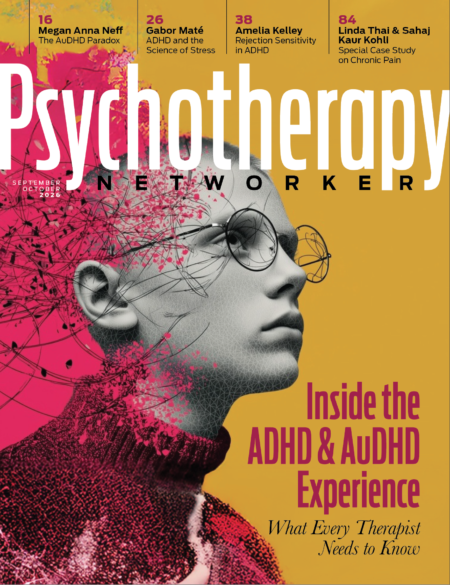

When a woman with ADHD comes to me for help, I almost always hear the same questions: What’s wrong with me? Why can’t I get my work done? Why can’t I get dinner together on time? Why can’t I have people over? Why am I late to everything? These questions resonate deeply with me. After all, I also happen to be a woman with ADHD, which means I was a girl with ADHD, a young mom with ADHD, a young clinician with ADHD, and now, I’m an older clinician and mom with ADHD. My lived experience and clinical practice have taught me things I wish more people—including many in our own field—understood about how ADHD presents differently in girls and women.
In my practice, I work with many of these women. They’re bright and talented—and they’re suffering. Many were diagnosed with ADHD later in life, and are wrestling with grief over their “lost years,” when their difficulties didn’t have a name and their symptoms were seen as character flaws. Many find it difficult to maintain friendships, forgetting to call and connect with people they care about. And their romantic relationships are often filled with misunderstanding and conflict, especially when a non-ADHD partner fails to understand them. In stark contrast to how society often thinks about boys and men with ADHD—more externalized, less misconstrued, and less stigmatized—these women have gone through life hearing things like, She’s chronically unhappy and can’t keep up with life. When these messages get internalized, they often result in misdiagnoses related to depression or anxiety.
Then there are the women whose ADHD is undiagnosed. They often come into our offices simply feeling overwhelmed. They compare themselves to other women who seem to manage their lives more successfully, and they wonder why they don’t measure up. Gender roles have always been unequal—women are frequently expected to do more than their fair share of parenting and housework—but for women with ADHD, the added burden of sexism only amplifies their feelings of failure and inadequacy.
A Roller Coaster Ride
When I was a child in the ’60s, nobody diagnosed me with ADHD. I wasn’t rambunctious, I didn’t act out, and I didn’t shoot spit balls or shove kids in the playground. Like so many girls around this time, my ADHD was missed because I didn’t have behavioral problems. I was a daydreaming teacher’s pet who didn’t stir anything up. But man, was I disorganized! My school desk looked like an exploding garbage truck. Library books disappeared in the chaos of my bedroom, whose floor was covered with projects, typically unfinished. This meant that week after week, I failed to earn my coveted allowance. Eventually, I figured out that shoving everything in my closet would earn me my cherished 75 cents each week, but I simply couldn’t get organized. I even unintentionally killed my beloved pet turtle, Joey, after forgetting to feed him and refill his water dish one too many times. Poor thing.
Once I entered middle school, life became harder since I could no longer keep up academically. My natural abilities that had made me a superstar in elementary school no longer seemed to work. My mind was constantly elsewhere. I couldn’t study, I gave up on homework, and I gave up on myself. Adding insult to injury, I started experiencing intense anxiety, and it wasn’t long before my sense of self-worth took a nosedive. Fortunately, college gave me a new lease on life. I had more control over my academic options, and I chose a path well suited to my strengths.
Like so many women, I’d learned to mask my struggles. As a top student and a people-pleaser with many friends, nobody would’ve thought I was struggling. But my childhood disorganization followed me into my college years. I procrastinated on writing assignments and crammed for big exams the night before. In fact, I became a master at procrastination (in many ways, I still am one). But in my earlier years, I battled daily with severe school phobia, feelings of dread and worry, and separation anxiety.
Years later, life got even more complicated: I became a wife and mother and found that my children needed consistency, structure, and dinner on the table each night by six o’clock. Add in the fact that both of my kids were exceptionally active and one had significant special needs, and I felt totally adrift. I was convinced I was a terrible mother, and before long, my daughter’s hyperactivity drove me into a state of high anxiety and my overwhelm reached new heights, where life felt almost too hard to manage.
Looking back, it felt like my small, messy childhood bedroom had been a preview of life to come: a house filled with clutter and chaos. Instead of being littered with my own toys, puzzles, and dolls, the space was filled with unopened mail, laundry baskets of unwashed clothes, piles of dirty plates, multiple junk drawers, unsigned school permission slips, and another generation of toys, puzzles, and dolls. Countless little paper slips were scattered throughout the house, scrawled with handwritten reminders of tasks that had long needed my attention.
After my youngest child survived a horrific illness that led to significant disabilities and severe ADHD symptoms, something dawned on me: we shared many of the same traits, particularly disorganization and forgetfulness. This discovery in my early 40s prompted me to see a prominent expert on adult ADHD, who evaluated and diagnosed me. ADHD contains three subtypes—or “presentations,” as they’re called in the DSM-5: hyperactive-impulsive type, combined type, and inattentive type. I land in the last category—the most commonly seen subtype in girls and women, and the most commonly missed.
My specialist also recommended psychotherapy and medication treatment, which meant referrals to a therapist and psychiatrist, both of whom specialized in working with adult ADHD. Once again, my life changed dramatically—only now in a good way. I began learning how my ADHD brain worked, and how to work with it instead of against it. I learned strategies to better manage my symptoms and began to process the poor self-esteem that had come from years of living undiagnosed.
Falling Through the Cracks
My story isn’t uncommon. Roughly five percent of adult women in the U.S. have ADHD, and increased public awareness means that figure is climbing. Still, our field has been slow to meet the growing need. In fact, ADHD in adult women wasn’t even fully recognized until the 1990s. Even now, when a woman with undiagnosed ADHD comes to a clinician seeking help, she’s more likely to be given a diagnosis of depression, a prescription for an antidepressant, and a referral for long-term psychotherapy. ADHD has comorbidities such as depression, anxiety, mood disorder, PTSD/trauma, and substance use disorder—and lots of other young girls and women with ADHD are misdiagnosed with these conditions. Then, after years of therapy and meds, they don’t get better and are left in despair, wondering, What’s wrong with me? Their clinicians often become frustrated, too, and may question their skills or blame the client for not wanting to get better.
For most adults diagnosed with ADHD, a combination of medication, therapy, and ADHD coaching help a lot, so communication between professionals in a treatment team is essential. It’s also important to note that most clients with ADHD rarely find symptom relief with the first medication prescribed; it can take a while to find one that works and doesn’t have problematic side effects.
Therapy and medication don’t make ADHD go away—nothing does—but they can improve life dramatically, like they did for me. When I was newly diagnosed, I learned strategies to help keep things together, thanks to a therapist who understood ADHD in women. I still navigate a plethora of hypersensitivities every day, from clothes that feel too itchy to odors that knock me off my feet to difficulty expressing myself when I’m overloaded with strong feelings. But my life today is much better than it used to be.
I’ve also found adjuncts to traditional treatment helpful. Jogging, yoga, and meditation have worked wonders for me. Attending support groups for people with ADHD was crucial in my early post-diagnosis years; I no longer felt alone. My clients have told me that support groups have helped them feel understood and accepted, sometimes for the first time in their lives. And a good couples therapist who understands ADHD can help partners improve their communication so non-ADHD partners better understand the dynamics at play. ADHD is no walk in the park, but it’s also not a death sentence.
What Can Clinicians Do?
As clinicians, we need to listen carefully to the stories our clients tell us about their early school experiences. How did they interact with peers? Did they struggle to finish schoolwork? Did they get poor grades even though they were capable? And today, are they in a career that matches their strengths and abilities, or are they underemployed, underpaid, and unhappy? Have their interpersonal relationships been healthy? We also need to understand that many ADHD symptoms and challenges will intensify as a woman ages and her hormones shift, especially in perimenopause and menopause. It’s one of the most common reasons why women in midlife or later reach out to us for help.
Menopausal and postmenopausal women deal with the loss of estrogen, causing brain fog, memory issues, mood changes, and physical and emotional fluctuations, which they sometimes misread as signs of early dementia. Sadly, since most women seeking help are diagnosed with depression and given antidepressants that don’t help, they spend years riding a rollercoaster of defeat, and leave therapy feeling even more defeated.
Undiagnosed girls and women hit different barriers across their lifespan, including when they first get their period and experience the fluctuations in mood, energy, and sleep, when they’re starting college and lose the structure of home and parents, when they’re entering a competitive and taxing job market, and when they’re starting a family and the focus shifts to the needs of their young children.
At these junctures and other life changes that throw a woman off course, early traumas and PTSD symptoms may overlap with ADHD traits in ways that make diagnosing tricky. This was my situation, with my severe comorbid anxiety disorder, a history of early trauma, and undiagnosed ADHD. Had I been treated appropriately when I was younger, my life would’ve been far different. It’s why I recommend that clinicians who are unsure how to diagnose refer clients for a neuropsychological evaluation, so they can tease out exactly what’s going on.
As a field, we’re playing catch-up. Back in graduate school, most of us weren’t taught much about ADHD in women—or about ADHD in adults at all. But now, we can close that knowledge gap. We can help eliminate the stigma. We can help people be kinder to themselves and give them the tools to better manage their symptoms. We can eliminate years of unnecessary suffering. It starts with changing how we listen.

Terry Matlen
Terry Matlen, LMSW, is a psychotherapist and the author of The Queen of Distraction and Survival Tips for Women with ADHD. She presents nationally for PESI on ADHD in women, and has been interviewed on NPR and quoted in The New York Times and The Washington Post. She offers online consultations for women with ADHD at ADDconsults.com.