
We asked three expert therapists to tell us about what they’ve seen recently that transported them, entertained them, or made them think about therapy and their clients. What they shared ranged from a tragi-comedy reimagining of a marriage gone wrong to a decades-old Lebanese gem—five films in all. But not every response involved a movie. One was a form of entertainment we didn’t expect—a chicken in sunglasses.

“Bait”
At the recommendation of my husband, I recently found myself watching Bait, a six-episode Prime Video comedy created by and starring Riz Ahmed. The show’s protagonist is Shah Latif, a British Pakistani actor whose career has stalled—until he gets called for a full-costume screen test to be cast as the next James Bond. It’s the opportunity of a lifetime—and he blows it. Not only does he forget his lines, but he also then tries to convince the white director that it was because he was dizzy from fasting for Ramadan (though he had been guzzling apple juice throughout the audition).
Shah is told he won’t get the part and asked to leave the studio surreptitiously to avoid the paparazzi. Instead, hoping to keep himself relevant and in the running, he walks out the front door so he’ll be photographed leaving the studio. That one action sets off the chaos ahead that unfolds from a kind of tragi-comic fever dream.
Watching this show, my heart broke for Shah. He’s a relatable character filled with insecurities, and as an AEDP practitioner and emotions educator, I couldn’t help mapping Shah’s emotional breakdown onto a tool I use with clients called the Change Triangle, a three-cornered map of how emotions work in the mind and body.
At the top left of the inverted triangle sit his defenses: the deflections, twisted self-narratives, and busywork he generates to avoid facing what’s underneath. At the top right sit his inhibitory emotions—anxiety, shame—the ones that mask his emotional truth. And his core emotions are at the base of the inverted triangle: adaptive feelings like sadness, fear, and especially rage.
The paparazzi photo of Shah in his James Bond costume sets off an internet storm in response to the idea of a Muslim playing James Bond. In an act of protest and Islamophobia, someone hurls a pig’s head through the living room window of Shah’s family home. The pig’s head becomes a symbol of the aggression Shah has endured throughout his life—and of the aggression he’s turned against himself.
Eventually, his mind plunges him into delusions and hallucinations in the form of a talking pig—his harsh internal critic externalized and played by Sir Patrick Stewart. What we’re witnessing, in comic form, is the impact of repeated experiences of being invalidated, judged, abused, and unseen. Such experiences evoke such overwhelming core emotions that anxiety, shame, and guilt move in to inhibit them. And because this mix of core and inhibitory emotions coursing through the body can be so painful, the mind erects defenses—the brilliant and creative ways we learn to cope. While we can’t stop core emotions from occurring—they evolved to help us survive—we can work with our emotions to change the direction of the downward spiral.
In AEDP, we define psychopathology as the result of being overwhelmed by emotions in the face of too much aloneness. Since children have immature nervous systems, they need adult support to navigate big emotions. However, most adults don’t know how to validate their own or their children’s emotions, so they end up unwittingly teaching kids to “tough it out” alone.
We see many scenes of Shah being physically and verbally bullied by relatives and boys from his neighborhood. We witness scenes depicting Shah’s mother as controlling and competitive and his father as emotionally disengaged. Without enough emotional support, Shah learned to manage painful feelings largely on his own, leaving him vulnerable to anxiety and insecurity. Now, an adult under the stress of having to prove himself as an actor, he begins what the show depicts over several episodes as a nervous breakdown.
Although this is comedy, it’s painful to witness Shah spiral into defenses like grandiosity, avoidance, and a kind of manic self-mythologizing about what this role as James Bond means about his own value. These aren’t character flaws to judge; they’re protective structures that exist because what’s underneath is too much to feel directly: a lifetime of being judged, bullied, underestimated, and victimized by prejudice. These injustices have stoked a simmering rage.
Critics have noted that Bait is sometimes skittish, darting between subplots instead of settling into a familiar narrative rhythm. I’d suggest that skittishness is a stylistic choice, one that allows the viewer to feel Shah’s anxiety. The show moves fast so Shah doesn’t have to sit still with the rage building beneath the surface at having to audition not just for 007 but, all his life, for his own identity.
The most affecting scenes are the quieter ones with his ex, Yasmin—where the pace slows enough for something truer to surface. That’s the therapeutic arc in dramatic form: defenses loosen, anxiety gets tolerated instead of avoided, and underneath, real feelings—including rage—emerge.
In AEDP therapy, we help people experience anger with a technique called a fantasy rage portrayal. The anger clients feel arises in the body, and we help them safely imagine its impulses toward perpetrators within the container of a session. In Bait, Shah experiences a waking delusion of kicking the asses of his bullies and persecutors. He also dreams of killing family members who failed him in one way or another. In these fantasies, the rage he’s spent a lifetime suppressing finally gets expression. Once he can experience the anger rather than defend against it, something shifts: he emerges with greater access to his love for his family and the confidence to perfect his audition.
Shah’s story isn’t really about acting or James Bond. It’s about what happens when a person stops outrunning his core emotions long enough to feel and move through them—and discovers who he is on the other side.

“The Roses,” “Black Bag,” “Caramel” & “Extraordinary Attorney Woo”
The expressive arts, poetry, and cinema often hold up a mirror to our consulting rooms far better than a textbook ever could. As a social psychologist who specializes in relationships, I’m endlessly fascinated by stories that reveal the subtle power shifts in couples, the cultural scripts around our bodies, and how we negotiate vulnerability when the stakes feel high. I often come away from sessions with a running list of movies, podcasts, and books my clients are into, and in my free time, I try to get through as many as I can. This helps me build a richer inventory of resources for all of my clients. Also, sharing these reference points creates a common language—a creative bridge that builds rapport and helps us explore complex themes together.
Over the past few months, four very different screen stories have stayed with me, sparking deep reflections on the unseen dynamics our clients bring to our offices.
The first is The Roses, Jay Roach’s sleek reimagining of The War of the Roses. Watching Benedict Cumberbatch and Olivia Colman play a couple whose marriage disintegrates when their professional power balance flips is both mesmerizing and deeply uncomfortable. What makes it even richer is how their surrounding social circle—their friends, neighbors, and colleagues—act as an echo chamber of societal expectations and passive-aggressive comparisons. It made me reflect on couples who come to us in crisis not because they don’t care for one another anymore, but because unexamined roles and external social pressures have fractured their foundation. When one partner’s ambition eclipses the other’s, their attachment system can glitch, turning a lover into a competitor.
Next is Steven Soderbergh’s Black Bag, an espionage thriller starring Cate Blanchett and Michael Fassbender as intelligence agents whose marriage collides with professional suspicion. While it’s wrapped in high-stakes intrigue, what hit me clinically is its metaphor for the invisible “black bags” all partners carry—the secrets, hypervigilance, and unspoken loyalties. It got me thinking about clients struggling with trust: Can true intimacy survive without absolute transparency? How do we hold space for a partner when self-protection demands we keep our guard up? Also, there’s a therapy scene in the movie that made me so uncomfortable! I don’t want to spoil it for you, so I won’t share details—but I will say that it was a stark reminder of why outside motives should never pollute the therapeutic space.
On a completely different, deeply sensual frequency is Nadine Labaki’s Caramel. This is an older movie I just watched. Set in a bustling Beirut beauty salon, it weaves together the lives of several Lebanese women, but it was the character of Jamale—a middle-aged woman secretly faking her period to hide her menopause—that broke my heart. Watching her navigate the invisible shame of becoming an aging woman in a society that ties female worth strictly to youthful desirability was profound. I immediately thought how universal this experience is and thought of female clients grieving their changing bodies in secret, carrying the heavy weight of social conditioning around sexual agency. Yet, the warmth of the salon—the collective rhythm of female friendship and neighborhood solidarity—brought a sense of warmth to me with its healing power of shared connection.
Finally, for something affirming, I recently binged the South Korean series Extraordinary Attorney Woo. Woo Young-woo, a brilliant autistic lawyer, steps into her first romance with a colleague. What I loved so deeply was how delicately it handled neurodivergent intimacy, completely dismantling the misbelief that autistic individuals lack desire or emotional depth. Watching them navigate sensory boundaries, communication differences, and the quiet beauty of a relationship built on explicit consent was pure joy. I found myself thinking of neurodivergent clients who so rarely get to see their relational longings mirrored with such dignity and tenderness on screen. I’m recommending this one to many of my clients.
Whether it’s the shame of aging, the terrifying vulnerability of neurodivergent love, or the slow-burn dismantling of a long-term marriage, these stories are great reminders of how beautiful and diverse humans are and why we do the sometimes-mystifying things we do.
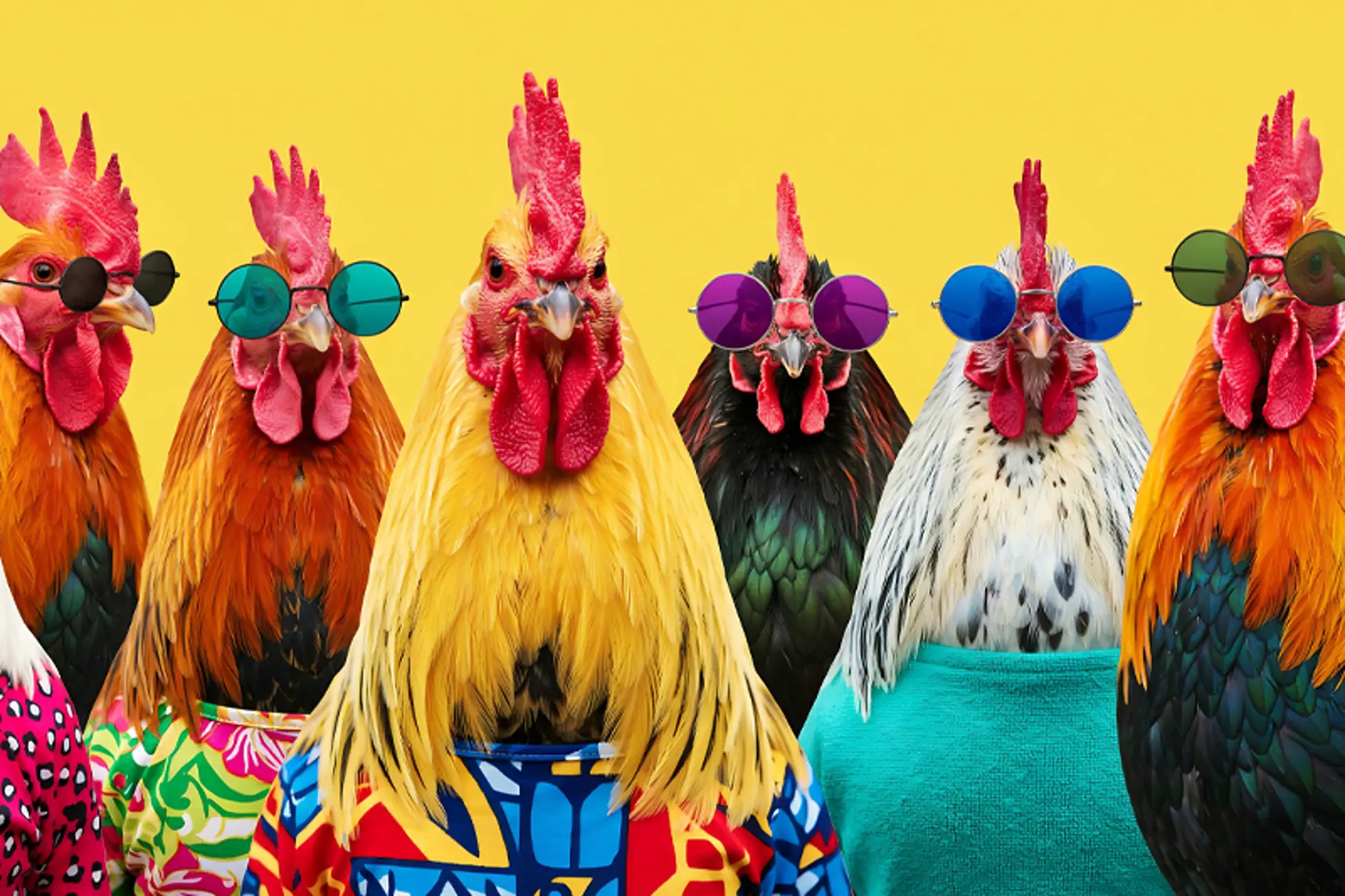
Chickens in Sunglasses
When my therapist friends aren’t working, many of them listen to endless podcasts about finding balance, discovering better ways to help clients manage stress, or getting “fair and balanced” political news. A few take classes on great art, music through the ages, and Stoicism.
I have more embarrassing, less lofty ways of relaxing. Sure, sometimes I download apps that promise to teach me about art, tell me everything there is to know about the cello (my favorite instrument), and guide me toward small independent films and documentaries. But my favorite way to unwind is watching animal videos, especially of animals being kind to one another. A goose befriending a cow. A mother cat adopting a rat. Especially in this political climate, these videos are a good reminder that unexpected kindness is everywhere if you look in the right places, and they give me a sense of necessary hope.
Not too long ago, I came upon a video about an old sheep named Fiona who’d been living alone at the foot of the coastal cliffs in the Scottish Highlands for two years. Unshorn, she had 20 pounds of matted gray wool on her body. Without a flock to socialize with, all she could do was eat grass, and she’d grown very fat. A team of farmers finally hauled her up the cliff and brought her to a farm, where someone spent hours gently trimming away the heavy, matted wool. Once Fiona was free of her burdensome coat, she romped and played in the fields. I watched that video over and over for days.
But most of all, I like watching chicken videos. Chickens riding motorcycles, chickens dancing by moonlight, chickens making friends with goats, chickens in love, chickens playing guitars, chickens in outer space. Something almost magical happens in my body when I watch them. Seeing a chicken driving a car in a scarf and holding a purse is so completely incongruous that laughter comes easily—a welcome release after a long day of listening to people speak about their pain.
Unlike doing something that would have me reflect on my work with clients, or sinking into a serious book or film, there’s no deeper meaning to follow. Chicken videos engage me without asking anything of me. A chicken in a hat is trivial, ridiculous, and funny. And yet something real is still happening when I watch @sammichicken or @binoothechicken. It feels like a nervous system reset.
A chicken in sunglasses doesn’t call for vigilance, accurate empathy, the low hum of validation, or the question, “Am I getting this right?” There’s no attunement required, no interpretation to hold, no repair to track. My body registers the difference before I do—the exhale arrives before the thought Oh, I can relax now. It’s less a technique than a default state my body finds when the need for vigilance disappears.
As it turns out, I had some formative experiences with chickens. (Okay, so maybe there’s no relief for a therapist without us eventually making deeper meaning of it.) An older relative of mine with dementia lived at Napa State Hospital, California, in the district everyone called Imola. (In the early 1920s, it was called the Napa State Asylum for the Insane.) On Sundays, I went to visit her. My parents dutifully disappeared into the building where she was housed, leaving me free to roam the grounds.
On one of those visits, I discovered a huge fenced-in area with a big red barn and chickens running everywhere. A large man named Gus, with a bronze-colored beard and red suspenders, a gentle soul who may himself have been a patient at the hospital, noticed me and showed me around. He introduced me to his favorite chickens, Assumpta, Imelda, and Bernadette, named after nuns he’d known, and he told me stories about how distinct their personalities were as we laughed at their antics.
Over several visits, I learned that Gus had been raised in Brooklyn, where his Irish father insisted on Catholic schools to “keep the boy in line.” I was 10, but I still noticed a dark cloud pass over his face when he spoke of his father. Once Bernadette went after a hen twice her size, squawking like she owned the yard, and Gus said, “In spite of her halo of white feathers, she’s a bully disguised as an angel, just like my father.” Even though that dark cloud crossed his face, we laughed as we watched Bernadette strutting toward us with her chest puffed out.
When I became a therapist, humor like the kind Gus and I shared accompanied me into my sessions and consultation groups. It was a balm when grief weighed me down and a much-needed distraction from overwhelm. For a while, my sense of humor was a bit dark and wicked. But now, apparently, I’m back to laughing at chickens at eleven at night. My nervous system has always known what to do with the unbearable: find the absurd thread in it and pull. The chickens are just the purest version, nothing unbearable attached, just the reset itself.
So there it is: long before social media, there was a state hospital, a man named Gus, and a flock of marvelous chickens showing me how to reset from the seriousness of life.

Hilary Jacobs Hendel
Hilary Jacobs Hendel, LCSW, is a certified psychoanalyst and certified AEDP psychotherapist and supervisor. She’s the author of the award-winning book, It’s Not Always Depression and co-author of Parents Have Feelings, Too, which recently won the American Book Fest best book award in the health category. Hilary is also co-developer of the Emotions Education 101™ Turnkey Curriculum and the Teen, Preteen, and Caregiver 2-hour Change Triangle Workshop Curriculum. Her blog is read worldwide. Find free resources for emotional health at Hilaryjacobshendel.com

Sara Nasserzadeh
Sara Nasserzadeh, PhD, is a social psychologist, speaker and thinking partner specializing in sexuality, relationships, and intercultural fluency. She’s authored three books, including Love by Design: 6 Ingredients for a Lifetime of Love, winner of the 2025 Vincent Clark Award from the California Association for Marriage and Family Therapists. She’s a Certified Sexuality Counselor and AASECT-approved provider, a Senior Accredited Member and Supervisor with COSRT (UK), and an Associate Marriage and Family Therapist in California.

Linda Carroll
Linda Carroll, LMFT, has practiced psychotherapy since 1981. She is an Imago therapist, trained in Level 2 Gottman Method Couples Therapy, and completed coach training through the Institute for Life Coach Training, certified by the National Board for Certified Counselors. She is the author of Love Cycles: The Five Essential Stages of Lasting Love and Love Skills, both published by New World Library.