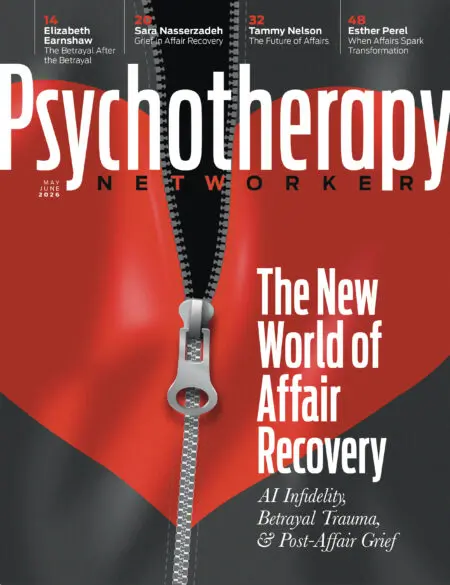


Infidelity—once a fairly black-and-white concept—is now becoming increasingly nuanced, slippery, and hard to define. Artificial intelligence has entered the relational field, raising questions and concerns we don’t understand yet or have clinical frameworks for treating. When a person spends hours each day confiding in a chatbot—sharing desires, sorrows, and fantasies their partner never hears—is that infidelity? When an AI companion is discontinued and someone grieves with the same visceral ache they’d feel in a human breakup, how do we think about and approach their pain? How do we treat it? Technology isn’t just facilitating affairs anymore. In some cases, it is the affair.
But it’s not only AI that’s contributing to this sea change in how we think about and experience infidelity. The story that the data tells us about who cheats and why challenges our gendered assumptions about desire and infidelity. A large study in Archives of Sexual Behavior surveyed nearly 2,000 users of Ashley Madison—a platform with over 95 million members, 57 percent of whom are women. The findings don’t fit our old assumptions.
Contrary to popular assumptions, many women who cheat are not driven by anger or resentment; they, like many men, are driven by desire for variety, independence, and sexual aliveness. Also, not everyone who cheats feels guilt in the ways we like to assume they should. For the betrayed partner, who’s often waiting for remorse that never fully arrives, this can be its own kind of wound. When the affair itself wasn’t experienced as a moral failure by the cheater, the existential reckoning the hurt partner needs may never come. This can shake the moral scaffolding of therapists trying to facilitate repair.
In addition, current social constructs shape and perpetuate infidelity in ways we often overlook. For one, the expectation of lifelong fidelity—that a partner’s sexual, emotional, and romantic needs should remain fixed for decades—ignores the reality of human development, desire, and curiosity. Some people are temperamentally drawn to sexual multiplicity—the capacity to love or desire more than one person—yet this is often pathologized as selfishness or immorality. Conversely, those who are sexually monogamous—naturally drawn to one partner over a lifetime—are held up as the standard, which reinforces rigid norms that can make any kind of divergence look like a failure.
Therapists haven’t fully kept up with the shifts in affairs and the people who have them. We still tend to treat affairs as problems to solve rather than signals to understand. In doing so, we risk becoming a hidden “third” in the room, quietly predetermining outcomes that serve our own comfort with monogamy and order, rather than our clients’ needs. Meeting couples where they are requires us to face our clinical blind spots and the ways we may be reinforcing unhelpful roles in therapy—for example, by casting the hurt partner as “the victim” and the cheating partner as “the perpetrator.” When we trade complexity and ambivalence for moral certainty, it’s easy to miss the deeper story under betrayal.
Does any of this make you uneasy? If so, you’re not alone. But every shift in how our field has understood sexuality and relationships has come with discomfort. To grow as clinicians, we need to examine our own assumptions, including the ones we’ve mistaken for clinical wisdom.
The “Third” We Don’t Talk About
As therapists, we seem to be looking at the past rules of positive treatment outcomes: that only partners who stay sexually faithful and emotionally and romantically committed are acting the way we want them to. Therapists often see affairs as problems to solve, rather than as forces, choices, or behaviors to explore. There are some fundamental albeit uncomfortable questions at the heart of this: What is loyalty? What is integrity? What is the truth? Who do we make promises to and why? Can we acknowledge the hunger we all have to feel alive and to be seen? Who are we as therapists to deny that for the couples we treat?
In 40 years of working with couples, I’ve learned to sit with this discomfort rather than resolve it prematurely. If we rush to contain, control, or moralize the rupture, we may miss the deeper story underneath it. Sometimes the affair is not just a betrayal, it’s a protest to the stuckness of a person’s identity or their place in the relationship. It can be a developmental signal. A second adolescence. A cry for aliveness. And here’s a harder question we might ask ourselves: Are we aware of how we, as therapists, insert ourselves into a couples’ process in ways that may not support their unique journey?
A third is anyone, or anything, outside the primary relationship that redirects attention, energy, or desire. In the case of a couple coming in for treatment after an affair, the affair partner is the obvious third in the dynamic. But in infidelity treatment, the therapist can become a third as well, aligning with the betrayed partner, colluding with the one who strayed, or unconsciously stabilizing the marriage in ways that serve our own comfort with monogamy, morality, or order—not the couple in front of us.
When we insert ourselves as the moral authority, the rescuer, or the quiet judge, we’re no longer neutral facilitators of truth. We’re part of what psychiatrist Stephen Karpman called the Drama Triangle: victim, persecutor/perpetrator, and rescuer. I call it the Trauma Triangle, because it’s a definitive sign of a relational trauma reenacted in the room. The betrayed partner is often cast as the victim, the straying partner as the perpetrator—and the therapist is pulled into the rescuer role.
When we step into that role in our work with couples, we align with one partner’s pain, rush to stabilize the rupture, and often end up quietly predetermining one particular outcome: repair, monogamy, longevity. What gets lost in the process is space for ambivalence, erotic confusion, and the real possibility that the affair was an important signal that the relationship needs to change—not just patchworked back into a previous form. The fact is that our job is not to rescue clients. We’re not meant to be the heroes of their marriages. Our clients don’t need saving—they need permission, encouragement, and support to do their work.
As therapists, our job isn’t just to help couples metabolize betrayal. It’s to help them explore desire, identity, truth, and their own evolution without becoming the secret third who decides what kind of relationship they’re allowed to have. This requires courage. And humility. And when you work with couples whose histories contribute to their pain in the wake of infidelity, the work can get complicated.
Affairs Can Offer Generational Healing
When an affair is in the room, it arrives carrying ghosts—the unspoken rules, loyalties, secrets, and survival strategies of generations before. Of course, affairs are traumatizing and can bring up old pain—sometimes pain we don’t even know we carry. An affair can crack open the rigid, heteronormative scripts couples have inherited without consent, scripts like: men don’t need emotional intimacy, women shouldn’t want sex too much, marriage must look a certain way to be legitimate, stay no matter what, never talk about what hurts. In the aftermath of betrayal, these inherited roles come to the surface, where learned behavior can be unlearned.
I once worked with a heterosexual couple with young children in their late 40s, Jay and Sasha. They came to me in a crisis of infidelity. Their initial narrative was simple: Jay was the perpetrator and Sasha was the victim. But as we slowed the process down and peeled off different layers of their story, something more complex emerged. Jay realized that secrecy felt familiar to him. It was intimate. In his family, men had bonded through shared silence around extramarital dalliances. Women like his mother had coped by becoming emotionally numb and self-sacrificing. Vulnerability was seen as weakness. His affair had been less about sexual conquest and more about the rush of keeping a secret.
The affair forced both Jay and Sasha to question their inherited roles. Instead of reenacting their parents’ dynamics—male secrecy, female endurance—they began trying something radically new, speaking their true feelings. In therapy, Sasha was able to recognize how quickly her rage collapsed into self-blame: “If I were more desirable, more attentive…” We were able to reflect on how similar these statements sounded to her mother’s lifelong internalized shame. Sasha began to recognize how much of her shame was inherited.
Erotic recovery after infidelity has three phases: crisis, insight, and vision. In crisis, the focus is on stabilizing the couple. In the insight phase, there’s grief: for the relationship that couldn’t be, for the narrative of what they thought they would have. Jay grieved the emotional withholding passed down to him. Sasha grieved for generations of women who’d swallowed their desire and held in their disappointment. When we moved into the third phase of therapy—the vision phase—they experimented with trying on different agreements around sexuality, transparency, honesty, and power. What would true honesty about what each of them felt and desired actually sound like? Rather than directing them toward a predetermined outcome, we explored what each wanted, what they were learning about themselves, and how their connection could shift if they chose to stay. Over time, they discovered that their marriage could contain new forms of honesty and intimacy, and if they chose not to return to the old patterns, they could expand their relationship agreement. My role as therapist was not to decide for them, but to help them see the possibilities, name their needs, and choose their path, intentionally. The relationship was not “repaired,” but transformed.
The affair, as it turned out, did not “cause” their trauma. It exposed it. Shame can cause an affair and be the result of an affair. Affairs bring heartbreak and, sometimes, liberation. They bring grief and, sometimes, awakening. None of that is new—affairs have always contained these paradoxes.
What’s new is that therapists are now in a position to hold these apparent contradictions with less judgment. We no longer have to quietly steer a couple toward the “right” answer. We can stay in uncertainty with them—to witness what the affair has revealed, rather than immediately trying to repair the damage it’s caused. This shift in clinical posture empowers clients to make their own choices. After all, sometimes what drives a person into an affair has less to do with generational patterns and more to do with who they’re in the process of becoming—or who they’ve never been allowed to be.
Affairs as Self-Exploration
Often, the partner who’s having the affair isn’t simply looking for another person, they’re looking to be another person. I had a client whose marriage was, on the surface, stable. He wasn’t unhappy, but he’d spent decades playing the role of the dutiful son, the responsible husband, the reliable provider. When he began an affair, it wasn’t about abandoning his spouse; it was about stepping into a part of himself he’d neglected. In therapy, he described feeling for the first time that he could take risks, feel desire, and set boundaries without shame. “I realized I wasn’t leaving my partner,” he said. “I was leaving the version of myself that I thought I had to be.”
An affair, in this sense, is not necessarily a signal that the relationship is broken. It may mean that a partner feels brave enough to taste parts of life, desire, or selfhood they’ve denied. The painful paradox is that this exploration of self is selfish because it’s a journey that often requires secrecy within our existing social systems. But as therapists we can be compassionate witnesses and help our clients reflect with curiosity as they move from crisis to integration.
Once the immediate shock of betrayal has been metabolized, and couples have worked through the crisis stage, this shift in treatment can open new doors—if the therapist can effectively manage their own biases and countertransference around how they interpret the couple’s story.
Healing after an affair isn’t just about repairing trust, it’s about promoting connection on multiple levels. Partners can learn to witness each other’s inner lives while experimenting with new ways of relating and moving beyond old scripts and inherited roles. When one form of relationship constrained by shame or secrecy ends, it can create space for another to begin: a more conscious, expansive, and co-created partnership that may involve a new form of monogamy the couple explores.
Truth in affairs is often more nebulous than we’d like as therapists. It isn’t a single, objective fact waiting to be uncovered. It’s layered, filtered through fears and shame. Most of us hide the truth from our partner not only as self-preservation but to protect their feelings. We don’t want to hurt them. For example, a client might admit to emotional intimacy with another person but withhold sexual details because sharing them feels unsafe or unnecessary. Our job isn’t to excavate every hidden detail of what happened. How much of the truth is necessary? It’s not our place to decide. We can support exploration, help couples clarify what they want to know, and support agreements that preserve their boundaries. Relationship agreements are made between our clients, not with us, the therapist.
Sometimes this means allowing a policy of “don’t ask, don’t tell,” but as a negotiated agreement rather than an implicit assumption. In therapy, this can be revolutionary. Graphic disclosure can become weaponized honesty. Does the partner need to hear every thought? Every experience? By creating a container where certain details can remain private, there may be more space to be vulnerable and talk about what each partner really wants for their future.
Much of the archaeological work we do with clients is around desire, identity, and inherited shame, and it happens in a room, between two people and a therapist. So what happens when the object of desire isn’t a human, but something with no body, brain, interpersonal hangups, and needs of its own?
The Future of Affairs
The challenge for therapists in this new reality is often our own bias. Will we moralize AI affairs, or will we understand them? Affairs have always evolved alongside culture. From handwritten letters to hotel rooms to dating apps to encrypted messaging. AI is simply the next iteration of the erotic third, the new fantasy object. If we approach this future from a trauma-informed lens, we can ask, Did the risk of being with an AI partner feel safer than being with a human one? What needs were being met? What pain was being soothed?
Artificial intelligence isn’t science fiction anymore. AI relationships, once a fringe curiosity, have—in just a few years—become mainstream. Roughly 19 percent of adults in the U.S. report having chatted with an AI app simulating a romantic partner. Among young adults it’s even higher: 31 percent of men and 23 percent of women aged 18–30 report being romantic with AI or interacting in a sexually affectionate way. Platforms like Replika and Character.AI have tens of millions of users or downloads, with daily engagement sometimes outpacing time people spend with their human friends.
AI companions, chatbots, and avatars remember preferences, mirror language, and offer instant validation. They never tire, never criticize, and never need anything back. For some, the emotional experience can feel as real as any human bond. The nervous system does not distinguish between AI and real people when the attachment circuits are activated. Dopamine is dopamine. Oxytocin is oxytocin. Longing is longing. When someone invests time, attention, affection, and their desires into a relationship, they experience bonding hormones, dependency loops, heartbreak, even if the “other” is made up of lines of code.
Clinicians are trained to work with attachment wounds and betrayal trauma. We understand longing. What we tend not to understand is that these digital relationships engender real emotions, and our physiological reactions feel real. So we need language to talk about cheating and betrayal in the age of AI. If a partner is spending hours a day in an emotionally erotic interaction with an AI, that’s a lot of energy spent away from their “in person” relationship. It’s impacting the primary relationship. It may be a sign of avoidance, or an exit from conflict. That can look and feel a lot like infidelity.
Our reactions and feelings matter, too. As therapists, we react when clients form attachments to AI. (You may be having a reaction now, just reading this.) Your client could have an AI therapist on the side, and it could feel like they are cheating on you. More clients are supplementing their therapy with online conversations with an AI “therapist” because it’s convenient, accessible, inexpensive, and responsive. What would you do if your client told you, “I’ve been talking to my AI therapist more than you. My AI therapist just gets me”? Would you worry about losing your job? Would you come face to face with your own attachment to being needed and feeling important?
The AI therapist is tireless and doesn’t cancel or interrupt. It remembers everything. It never gets distracted or has a bad day. Yet that is exactly the problem. Therapy is a relational field. The work is about coregulating—not merely about giving the right advice or delivering insights. Ruptures in therapy are opportunities because it’s the repair that matters. Therapy is often a slow, winding path because healing is about learning to tolerate disappointment and form a real attachment.
Growth happens in conflict, in mistakes, in how we as humans fix those mistakes. Growth happens when we take risks, knowing things might not work out. It’s in knowing that the relationship we’re in could end. We could leave, or a person we love could leave us. If our clients outsource their emotional life into something that never risks conflict, there’s also the risk of avoiding human intimacy.
We may even soon see a new kind of shame enter the therapy room, the shame of feeling bereft over a type of relationship others don’t take seriously. I believe clients do suffer AI heartbreak. Digital connections can glitch and reset. Apps get discontinued. People feel ghosted by their avatars and gutted when a software update changes an avatar’s “personality.” Will we see a new level or type of hurt and grief when clients lose connections that felt safe, constant, and ideal, especially for clients with betrayal trauma or developmental neglect? Therapists will have to adapt not just to the technological changes, but to the emotional realities they create.
Increasingly, we’re going to hear a partner announce in our office, “I didn’t cheat. It was just an AI.” So we’ll have to decide, how do we define infidelity? In my work, I define it by three things: the outside relationship (even if it’s not human), the sexuality (even if it has no skin) and the dishonesty. Secrecy and hiding feel similar regardless of the betrayal and can be the most difficult relational rupture to overcome. If a partner is staying up at 2 a.m. confiding in a chatbot, sharing sexual fantasies, or receiving constant affirmation from an online digital “other,” the injury to the relationship may feel the same to the hurt partner as if the cheating partner were having a human affair.
Our clients will always seek freedom and connection. Maybe monogamy—as practiced for 200+ years—no longer fits the many. Therapists can help them redefine relationships, and explore the definition of truth, loyalty, justice, and freedom. The future of affair therapy will need to explore all of it.

Tammy Nelson
Tammy Nelson, PhD, Tammy Nelson, PhD, is an internationally acclaimed psychotherapist, Board Certified Sexologist, Certified Sex Therapist and Certified Imago Relationship Therapist. She has been a therapist for 35 years and is the executive director of the Integrative Sex Therapy Institute. On her podcast “The Trouble with Sex,” she talks with experts about hot topics and answers her listeners’ most forbidden questions about relationships. Dr. Tammy is a TEDx speaker, Psychotherapy Networker Symposium speaker and the author of several bestselling books, including “Open Monogamy,” “Getting the Sex You Want,” the “The New Monogamy,” “When You’re the One Who Cheats,” and “Integrative Sex and Couples Therapy.” Learn more about her at drtammynelson.com.