


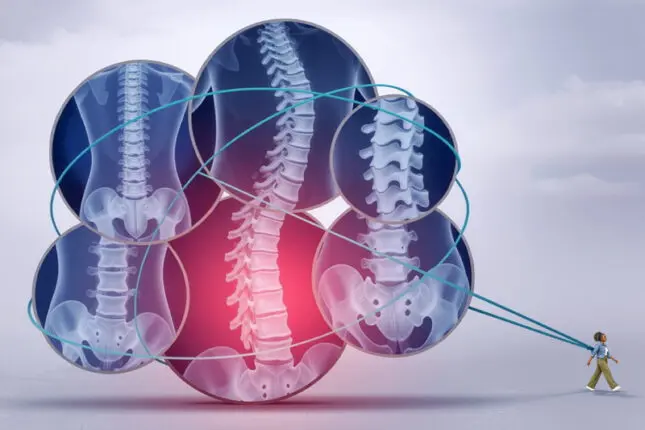
Remi called ahead to say she’s suffered from chronic back pain on and off since her early 20s, but that in the last year, it’s become debilitating. “I respect my doctor,” she mentioned, “who suggested I give therapy a try.”
Remi’s in her mid-50s, recently returned from New York, where she spent a decade engaged in diplomatic work for the United Nations. As she enters your office, she holds your gaze for a beat longer than usual, then nods—a wordless recalibration you’ve seen in other clients relieved to be working with a therapist of color.
When you ask about her life, there’s a weary, performative quality to her response. She grew up in Chicago, she tells you. Her mother’s people are from Georgia, and her father came from Côte d’Ivoire in the late ’70s. “My parents were very different, which is why they fell in love,” she says. “They were happy for a while, but then my father went back to his hometown and became obsessed with how the war had made the country unrecognizable.” She pauses. “I’m not really close to my family. I have a sister in Atlanta with four kids, and I help her out financially, but that’s it.”
When you ask about other relationships in her life, she shrugs. “I prefer situationships.” She winces, then shifts in her chair. “Listen, you seem great, but I don’t see how digging into the details of my less-than-perfect life is going to help my back pain go away.”
Moving at the Speed of Trust
Remi has been referred to therapy because her doctor can’t solve her pain. So it’s reasonable to assume she’s entering my office with the belief that if medicine hasn’t found an answer, the problem is somehow her. And now, here comes a therapist, ready to go searching through her life for the psychological explanation.
I don’t take the bait. Instead, I immediately tell Remi, “I’m not interested in convincing you that your pain is secretly psychological. I believe your back hurts.”
When I do, I see her look at me with confusion, and relief, but also suspicion. What would my agenda be if not to tell her what’s wrong with her? But I don’t think Remi needs another professional explaining her body to her. And the last thing I want to do is reinforce a false binary in which Remi’s pain must either be physical or psychological, “real” or emotionally driven.
As a narrative therapist, I’m interested in the stories that develop around our problems, particularly when those stories begin telling us something about who we are. Chronic pain may have begun as something Remi experiences, but over time, it turned into something that organizes her life. It can change what she does, what she expects from herself, how she relates to other people, what she imagines about her future, and even how she understands the person she has become.
Before I go looking for trauma, family dysfunction, or psychological explanations for her pain, I want to understand her relationship with herself and her body. But even before that, I want to know Remi and build rapport with her. It’s important to me that I meet her where she is and respect her agency around what we do or don’t explore.
I’m reminded of writer and activist adrienne maree brown’s famous guiding principle, “Move at the speed of trust.” This is what grounds my work with all my clients, including Remi. We can only go as deep and as fast as trust allows us. So I aim to build that trust.
I ask what it was like to walk in and realize her therapist is also a woman of color. Shared identity doesn’t automatically mean shared understanding, but I note the physical reaction I observed when she saw me. I also ask her about her concerns of being in therapy and what she believes about it.
When Remi starts to describe her skepticism, I decide to use self-disclosure: “I remember the first time I was in therapy—before I became a therapist—and my therapist was asking me all these questions that felt intrusive. They even felt wrong, like, ‘Why was I spending money and time talking about things that were trivial compared to what my parents and elders have lived through?’”
I see her shock and relief as her body settles. I keep going, “I’ve spent my whole career working with immigrants and their children because I know that ‘mental health’ in the way we talk about it in the West doesn’t always translate to our experiences or in our languages.”
She nods, “Yeah, mental health wasn’t even a word in my household. Plus, I’m here for back pain, which has nothing to do with my mental health.”
Rather than challenging her on this, I earnestly say, “Well, you’re the expert of your life and your body. I won’t claim to know better than you, but I do think I have skills and tools that may help you. I want to learn more about you, and I want to understand your relationship with your back and your experience with chronic pain. But I also don’t want to rush it. If you’re comfortable, I just want to get to know you a bit today.”
She visibly relaxes, so I ask about her family.
There’s a polished quality to the way she answers, almost as though she’s giving me a briefing. It makes me wonder: Who has Remi had to be for other people? What version of herself is easiest to present? What happens when she isn’t composed, impressive, useful, or self-contained? I store these thoughts for another time.
“What was that like for you when your father returned to Côte d’Ivoire?” I inquire.
She shrugs. “It was his country.” After a few seconds, she adds, “I mean, obviously it was sad. But people were dying. Families were losing everything. I wasn’t exactly going to sit there and say, ‘Dad, I’m upset you’re distracted.’”
I’m tempted to follow that thread, to wonder whether Remi learned that her feelings became harder to justify, or less than, when placed beside someone else’s suffering. But we’ve only just met, and I’m cautious about making definitive connections just yet. Instead, I say, “It sounds like there was always something bigger happening.”
She pauses and her face softens. “Exactly.”
“And when something bigger was happening, what happened to the smaller things?”
She laughs, without much humor. “You dealt with them.”
“By yourself?”
“Usually.” She shifts and reaches behind her lower back.
“Is that your back?” I ask.
“Yeah. Sitting too long.”
I resist the temptation to make the timing meaningful. Still, I want Remi to know I’m paying attention to the body she actually came here to talk about. “Do you need to stand?”
“I’m fine.”
“You don’t have to be fine for my benefit.”
She gives me a look that’s half amused, half irritated. But she stands. That moment feels more important to me than getting another piece of her family history. She’s told me, in a small way, that she’s uncomfortable—and I’ve believed her without requiring her to continue enduring it.
When she sits back down a minute later, I ask about her sister again.
“What does helping her mean to you?”
She looks confused. “It means she needs help and I can help.”
“Does it feel like closeness?”
“No.”
“Responsibility?”
“I wouldn’t call it that either.”
“What would you call it?”
“Family.”
I pause because if I use emotional disclosure or frequent contact as the primary markers of closeness, I might miss other ways Remi understands care. I don’t need to decide whether supporting her sister represents generosity, obligation, reciprocity, or cultural expectation. I need to understand what “family” means in Remi’s vocabulary without imposing my own definition.
“I’m curious about the situationships you mentioned before,” I say.
Remi winces.
“Your back again?”
“No,” she says. “That was embarrassment.”
“What’s embarrassing?”
“Come on. I’m 55 years old talking to her therapist about situationships.”
I’m noticing a few things in this moment. First, she’s called me “her” therapist. To me, the possessive pronoun signals a feeling of ownership over the therapeutic relationship. Therapy is no longer something happening to her but rather, it’s becoming something she’s actively participating in. At the same time, she’s talking about embarrassment—shame’s not-so-distant cousin. This is one of those moments when cultural responsiveness requires restraint. I have interpretations but voicing them now would tell Remi what I think her life means. Instead, I ask, “Do you actually prefer situationships to relationships?”
She laughs. “That’s an annoyingly good question.” After a moment she says, “I prefer parts of them.”
“What parts?”
“The freedom. Nobody needing to know where I am all the time. Nobody building their entire life around me.”
“And the parts you don’t prefer?”
She looks away. “Sometimes it would be nice if somebody noticed I disappeared.”
I let the silence sit.
Then she shakes her head. “See? This is exactly what I was talking about. I came here because my back hurts, and suddenly we’re talking about my father and my social life. I don’t see how digging into all this is going to make my back pain go away.”
“I don’t know that it will,” I say, but I do note her avoidance as we talk about the emotional pain she carries around relationships.
She looks surprised.
“I’m serious. I’m not interested in convincing you that your pain is secretly psychological. I believe your back hurts.”
Her face softens, but only slightly. “So what are we doing here?”
“That’s a fair question.” I think for a moment. “I’m interested in your story because I’m interested in you, Remi. I want to understand who you were before the pain became this loud. Your relationships, your family, your work, your losses, your values—they’ve all helped shape the stories you’ve come to tell yourself about who you are. Not because I think your past caused your back pain, but because I want to understand the story of you before pain entered it. Then, and only then, can we begin to ask how chronic pain may have started rewriting that story, or whether it has become the loudest voice in the room, crowding out the parts of you that existed long before your back ever hurt.”
I can tell she’s taking this in. She finally says, “I’ve had chronic pain for so long I don’t know who I am without it.”
“Chronic pain can become totalizing,” I validate. “A person who has done extraordinary things can slowly become ‘someone with chronic pain.’” Appointments, limitations, flare-ups, and disappointments occupy more and more narrative territory. These are important, but for now, I want to continue to know who Remi is outside the jurisdiction of her pain.
One place I look to is her work. I ask about her years in diplomacy, and she lights up. She tells me about negotiations, complicated personalities, and an award she received. Up until this point, I’d mostly met the woman living with chronic pain—discouraged, skeptical, hurting. The moment she talks about diplomacy, I meet the woman chronic pain has been trying to overshadow.
“You were good at this,” I say.
“Very good.” She thinks for a moment. “I listened. I could read a room before most people knew there was anything to read. I didn’t need somebody to be wrong for somebody else to be right.”
That stays with me.
Rather than only asking what pain has taken from Remi, I want to know what it hasn’t managed to take. When does she still feel like herself? Clearly, she was good at finding ways forward when no one got exactly what they wanted. I wonder aloud whether this skill could help her develop a different relationship with her body. Perhaps there’s another possibility besides fighting it or being defeated by it. “You said you were good at understanding competing positions without deciding one person had to be wrong,” I say.
She nods.
“What would it mean to approach your back that way? Not as an enemy to defeat or a mystery to solve, but as another party whose position you don’t fully understand yet?”
She’s quiet, and I’m quiet with her. I may eventually offer psychoeducation about the mind-body connection, chronic stress, and the nervous system. I may even collaborate with her physicians to better understand the medical treatment she’s receiving. But right now, Remi needs someone to investigate alongside her, not explain her body to her.
She says, “I haven’t thought about it that way. I just endure the pain because it is what it is. But approaching it like a negotiation….” She trails off.
Cultural responsiveness isn’t the ability to see someone’s identities and know what they mean—it’s recognizing which questions become possible because we’ve noticed them.
Before I interpret Remi’s pain, I want to give her the space to use her own voice and share what feels important and how she talks to herself. Culture, race, gender, family, age, immigration, intergenerational experiences, and professional identity may each have contributed stories about strength, independence, suffering, usefulness, need, and what deserves attention.
My job isn’t to decide which story is true. It’s to become curious about which stories organize her life now, and to move slowly and avoid rupturing what we’re trying to build.
Listening to the Body Differently
By Linda Thai
What I’m clocking about Remi is that she’s competent, guarded, and bone tired. She doesn’t feel resistant in a hostile way. She feels like somebody who has had to hold herself together for a long time. So I want to be steady, not flashy. I want to say just enough that she knows I’m tracking both the pain and the context. More importantly, I want her to feel connected with, as a Black woman.
“I’m really glad you came in,” I say. “And I want to say up front that I take your pain seriously.”
She exhales a little, but her arms stay close. “Good,” she says. “Because I’m not really into talking about my childhood when what I need is for my back to stop hurting.”
“That makes sense. And honestly, I don’t think we have to split the body off from the story,” I speak slowly. “A lot of people have been told pain is only medical, or only emotional, but the nervous system doesn’t really do that. It’s taking in the whole picture. Of everything that’s happening around you, and everything that has happened to you, and to your peoples, and how your body, your nervous system, your behaviors have adapted to or been re-shaped by those stressors.”
This is the moment to offer a little psychoeducation, but not too much. I watch her body language to see if she’s giving me an opening. I don’t want to lose her by sounding like I’m giving a lecture and yet I want to get real.
She shifts in her chair and presses a hand into her lower back. “So you’re saying this is psychological?”
“Not exactly,” I say. “I’m saying the pain is real. And sometimes the body is carrying more than just the injury or the strain. Chronic pain can get worse when somebody’s been under a lot of stress, when they’ve had to keep pushing, or when life has had them on high alert for too long.”
I watch Remi’s face for any flicker of tension or withdrawal, any sign that I might be going further than she’s ready for. I don’t see it. She’s straightened in her chair and looks energized. I pause with a little side eye that signals I’m about to spill some tea, and she softens and leans in. I go for it—code-switching just enough while maintaining a matter-of-fact manner.
“Most of my caseload is BIPOC. In this last year, during the current administration, with all the fuckery that’s been happening—the immigration raids, concentration camps and mass deportations, the dismantling of democracy’s checks and balances, the rollback of DEI, the final shredding of the Voting Rights Act.” I speak slowly so that I can track her response. She’s right there with me. “All my BIPOC clients are showing signs of stress, pain flare-ups, insomnia, appetite issues, GI issues, rage, and bone-tired fatigue.”
She nods, then shuts her eyes and sighs. I wait until she makes eye contact again. Then, I give her the head tilt, chin lift that signals I’m going in for another round.
“My clients whose emotions and bodies have been through the wringer this last year—somewhere in their history, their childhoods, there’s often an abusive, uncaring, or absent father who wreaked havoc. Or a neglectful parent who expected them to be the strong one, the one with the answers, and now that old pattern is colliding with this relentless wave of attacks on our dignity. The war in Iran has brought up refugee trauma for clients whose parents or ancestors survived war and forced displacement.”
I hold her gaze. She holds mine.
I’m feeling the interrelational space. I’m feeling her feeling me. I’m feeling me tracking and feeling her. Whether she knows right now that I’m a former child refugee or not isn’t important—it’s there on my website. What’s important is that we’re slowing down and being human together in this world.
I look away, take a breath, and then look back to her.
“My clients who are—were—federal employees have had it real bad. Like real bad. Workplace dynamics have shifted to mirror childhood home dynamics full of unpredictability and uncertainty, fear, and powerlessness. Feeling like you have to fight for your right to exist. And the moral injury of knowing what these funding cuts mean for the people you’ve dedicated yourself to serving.”
“I’ve had pain on and off for years,” Remi says, nodding. “But this last year has been brutal.”
“Yep, it sure has been,” I reflect back.
I’ve said enough.
I make eye contact and tilt my head down to signal: now you talk.
She looks away. “I’ve been handling a lot. My work. My family. Everything.”
It’s not easy for her to talk about herself. I keep quiet, give her space.
“My family’s a mess,” she says. “I mean, I help my sister financially, but I’m not close to anyone. And I’m used to keeping things moving. That’s just what I do.”
“You’ve been the one who keeps everything together,” I say.
“Yeah,” she says. “Pretty much.”
“Has it always been this way?”
“Yep.”
We pause and share a sigh of recognition.
This feels like the first real opening. There’s grief here, maybe loneliness, maybe the beginning of feeling seen. I’m also holding the possibility that she’s been overfunctioning for a long time—at work, in her family, probably in spaces where she had to stay polished and composed.
“This costs the body,” I say, a compassionate, wistful knowing tone in my voice. “Always being the one who keeps everything together. Over-riding your own needs. Getting your own self ahead in this world. Taking care of others however you can. Over-functioning is how we’ve managed to survive and how our peoples have managed to survive.”
I make direct eye contact with her as I say this last sentence.
“Sometimes pain is one of the places where the body finally says, ‘I can’t keep doing this the same way.’ Not because you’re weak, but because you’re human.”
She looks at me for a long moment. “I’ve never thought of it like that,” she says.
“A lot of people haven’t been offered that frame,” I say. “They’re told to push through, stay positive, prove they’re fine. But chronic pain and mental health often show up together because pain affects sleep, mood, digestion, concentration, relationships. And it also affects hope.”
Does Remi struggle with depression, hopelessness, perfectionism, and self-blame? Maybe. But I don’t allow myself to go there—not yet. I want her nervous system to sense I understand the bigger picture before either of our minds get distracted by labels.
“Our work isn’t to argue with your body,” I continue. “It’s to listen to it differently. To understand what it’s been holding, what it’s been bracing itself against, and what might help it feel safer over time.”
“Okay,” Remi says. Her guardedness has softened into something more vulnerable. “That sounds useful.”
From here, we might build a plan together that includes a symptom diary where she tracks the psychological and environmental factors that worsen or decrease her pain along with how she experiences it. I’ll stay attuned to where the language of parts might eventually support our work and keep tabs on where she is in terms of readiness for change (along the lines of Prochaska and DiClemente’s Stages of Change Model). And before our session ends, I’ll offer her something immediate she can experience for short-term pain relief—like Havening, a technique that combines touch and distraction to calm the nervous system. More important than any intervention, I want her to leave our session feeling deeply met and seen.

Linda Thai
Linda Thai, LMSW, is a trauma therapist who specializes in cutting edge brain- and body-based modalities for the healing of complex developmental trauma.

Sahaj Kaur Kohli
Sahaj Kaur Kohli, MAEd, LGPC, NCC, is a practicing therapist, international speaker, and the founder of Brown Girl Therapy (@browngirltherapy), the first and largest mental health and wellness community organization for adult children of immigrants. She’s the author of But What Will People Say?: Navigating Mental Health, Identity, Love, and Family Between Cultures and a columnist for The Washington Post’s advice column Ask Sahaj. She’s also the creator of The Bicultural Brief, a professional digest for helping professionals working across cultures. Her work has been featured in Today, Good Morning America, CNN, the New York Times, and HuffPost.