

Enjoy the audio preview version of this article—perfect for listening on the go.
Among all the issues clients bring to therapy, few are stickier than addictive behaviors and worry-driven habits. How do we not just challenge bad habits, but help enact lasting change? How do we retrain the underlying mechanisms driving them—and in a way that avoids the traps of guilt and shame?
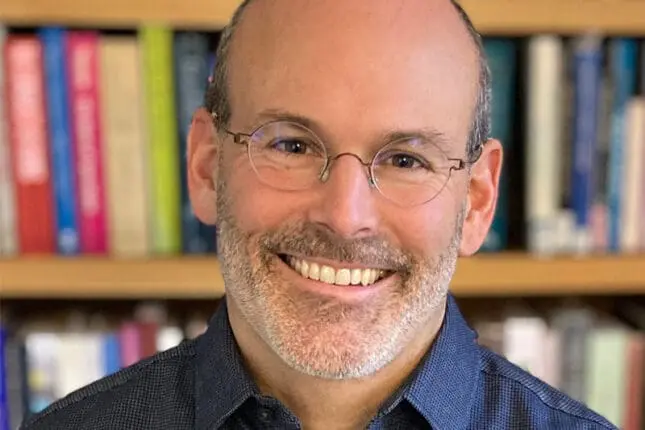
These questions were on my mind as I sat down to chat with Judson Brewer, a psychiatrist and researcher at Brown University, as well as a leading voice in the science of habit change. Combining cutting-edge neuroscience and the timeless wisdom of mindfulness, Brewer’s work explores how deeply ingrained behaviors—whether they’re driven by anxiety, addiction, or cravings—are formed, and more importantly, how they can be unformed. Rather than trying to force change, Brewer’s approach invites us to explore our natural curiosity, to work with the mind instead of against it.
In his New York Times bestselling books The Craving Mind and Unwinding Anxiety, Brewer translates complex brain science into practical tools that therapists and non-therapists alike can apply in their everyday work and lives. His groundbreaking perspectives have not only been featured in Time Magazine, The Washington Post, The New York Times, Forbes, and more, but his TED Talk, “A Simple Way to Break a Bad Habit,” has more than 15 million views on YouTube to date.
Ryan Howes: What drew you to focus on anxiety and habits in your work?
Jud Brewer: Suffering. A lot of people are suffering, and there are a lot of subpar treatments that have been the gold standard for years.
CBT, for example, has been the gold standard for what, 50 years? And it’s primarily focused on changing our cognitions. But from a neuroscience perspective, the essential elements of habit change are related more to reinforcement learning and reward processing than changing cognitions.
We know that habits change based on how rewarding something is, so we can’t really think our way out of a problem. We have to feel our way out of it. And when we feel how unrewarding a behavior is, then we naturally become disenchanted. That’s how we change it. That’s what Unwinding Anxiety is about—approaching anxiety from a neuroscience perspective, rather than thinking our way out of it or trying to figure out why we’re anxious by going back into our past.
As humans, we’re attached to the idea that we can reason our way out of problems. That’s not to say that reasoning isn’t helpful, but when it comes to changing emotionally based habits, we believe we have more control over our destiny than we probably do.
RH: A lot of your work focuses on the relationship between shame and food. Can you say more about that?
Brewer: People often eat to soothe themselves emotionally. It’s called hedonic hunger as opposed to homeostatic hunger. But that can feed spirals of shame, where we feel ashamed about not being able to control our eating, and often what we look like based on the caloric intake.
RH: How is craving different from hunger?
Brewer: When we have homeostatic, or physiologic, hunger, we can have a craving for food, which is normal. That urge to eat is dopaminergically driven. It creates a restless itch, making me want to go get some food. Hedonic hunger is not really hunger, but it describes how we learn to eat as a way to regulate our emotions. And that craving can feel exactly the same.
For years, I ran a group for patients with binge eating disorder. It took me a while to figure out that they didn’t know the difference between true physiologic hunger and hedonic hunger. One of my patients put it succinctly: “I just have an urge and I eat.” And she was like, “What’s hunger?” Often the signals can have a lot of overlap in terms of how they feel, but what drives them is very different.
RH: Is that “mindless eating”?
Brewer: Exactly. And the antidote is mindfulness and awareness. It fits so perfectly with what we understand from a neuroscientific standpoint of how habits change. It’s knowledge that’s been around for a while, since back in the ‘70s, when researchers Rescorla and Wagner talked about positive or negative prediction error. Basically, if you pay attention and see that something is more rewarding than expected, you’re going to do it more. And if you pay attention and see that it’s less rewarding than expected, you’re going to do it less. It’s the same formula that can be used to help people form healthy habits like kindness, generosity, gratitude, and compassion. You can form healthy habits in the same way you can break unhealthy habits. The primary driver here is awareness.
RH: You need to be aware of the outcome?
Brewer: Absolutely. You notice you have a craving for food, but you introduce an extra thought: What am I getting from this?
RH: You use the acronym RAIN, which is similar to the one originally coined by meditation teacher Michele McDonald and later adapted by psychologist Tara Brach.
Brewer: Yes, though in my version, the “n” stands for “noting” based on a practice popularized by the late Buddhist monk Mahasi Sayadaw. One way to bring the awareness to cravings is to use RAIN. Recognize: if you’re on autopilot and can’t recognize a habit, you can’t pinch it. Allow: if we don’t allow whatever feelings are driving the habit, we’re not going to be able to work with it. You have to get up close to the sensations of the habits to be able to change them, turning toward our experience, rather than running away from it.
Investigation brings an attitude of curiosity, which is the key attitude of mindfulness. So instead of resisting our experience where we’re like, “Oh no, if it’s happening again, I have to fight it” we instead ask, “Oh, what does this feel like?” It brings us into the present moment and helps us start to investigate what our physical sensations are, what a craving feels like, and how to sit with it and see these as simple physical sensations that aren’t terrible. They might be unpleasant, but we can actually be with them.
Noting is a pragmatic practice for helping people stay with their experience moment to moment, so they know the tightness, tension, itching, burning. Whatever the feeling of a sensation is—whether it’s anxiety or craving—they note it.
RH: Do anxiety and food habits have a similar root cause?
Brewer: They do, and we’ve identified mechanistically where both are driven through reinforcement learning. Anxiety is driven through negative reinforcement: the feeling of anxiety drives the mental behavior of worry, and then the feeling of doing something about it, or the illusion of control, is rewarding enough that it feeds back.
People often falsely associate problem-solving with worrying because if somebody is worrying a lot and they happen to solve a problem, they’ll get a false association where they think that because they worried, they solved the problem. In reality, they just happened to be worrying when they solved the problem.
RH: What are you working on now?
Brewer: We just created a scope-based program for anxiety called “Going Beyond Anxiety.” It’s available to anyone, and people can use their HSA to pay for it.
And we’ve found you can use a reinforcement learning process to help people develop healthy life skills, like practicing gratitude, generosity, kindness, integrity, and ethical conduct. We developed a skills-based program where we can actually incorporate all of this through lessons in audio and video formats. We pair this with an AI-based learning assistant that can check their comprehension and then through experiential education help employ it in their lives. It’s something I would do in my clinic, but scaled. We pilot-tested it last fall, and clients were saying they loved it.
RH: What would you recommend to therapists who encounter clients with problematic habits?
Brewer: This might sound controversial, but I’d say watch out for spending too much time on the why. When we focus more on the what, people can learn to work with anxiety as a habit, instead of something that they have to solve or discover from their past or childhood. They can bypass the stereotypes that people associate with psychotherapists.
RH: Yeah, that will ruffle some feathers.
Brewer: I’m happy to ruffle feathers because that’s what the data show. Whether it’s from our randomized control trials or in my clinic, focusing on the what really helps people a lot. And I think ultimately, psychotherapists are just trying to find the best way to help their patients.

Ryan Howes
Ryan Howes, Ph.D., ABPP is a Pasadena, California-based psychologist, musician, and author of the “Mental Health Journal for Men.” Learn more at ryanhowes.net.

Judson Brewer
Judson Brewer, MD, PhD, is an addiction psychiatrist, neuroscientist, and bestselling author whose research explores the neural mechanisms of mindfulness and behavior change. He’s the author of Unwinding Anxiety and The Craving Mind, and serves as Director of Research and Innovation at Brown University’s Mindfulness Center. He’s been featured in TIME Magazine, NPR, and The New York Times, and his TED Talk has over 38 million views.