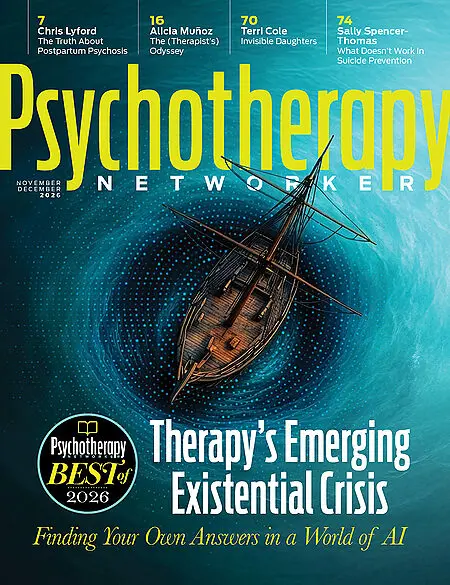

Since the dawn of humankind, we’ve been telling a version of the same story—someone leaves home, gets lost, endures enormous hardship, and returns transformed. The great mythologist Joseph Campbell traced this pattern from ancient indigenous tales to Homeric epics to modern ones like Star Wars and Moana. He called it the hero’s journey. And after seeing Christopher Nolan’s The Odyssey on the big screen this summer, Networker senior writer Alicia Muñoz and I started thinking about how apt a metaphor the hero’s journey is for what so many therapists are going through these days. Thus was born the lead story for this special issue.
In Alicia’s story, cheekily called “The (Therapist’s) Odyssey,” a therapist has been feeling burnt out and professionally adrift. She’s taken a multitude of training and certificate courses, but instead of filling her with a sense of confidence and direction, they’ve only blown her further off course. Where has her sense of awe and wonderment gone? How can she be an effective therapist in a world where clients are turning to chatbots for emotional support, actual therapy sessions are being screened by AI agents looking to recoup payouts, and the only way to build a thriving career is seemingly to become a social media influencer?
To shake off these uncomfortable questions, our therapist decides to see a matinee showing of The Odyssey before her evening client shows up. Only what she finds in the theater takes her on her own journey of discovery, where Orna Guralnik, Showtime’s Couples Therapy star and the oracle of this story, guides her through the challenges of a rapidly changing profession. Along the way, she meets Janina Fisher, who gives her clarity on her never-ending quest for CE training. Renowned psychiatrist Allen Frances helps her escape from an AI cyclops tending to a flock of deceptively validating AI sheep. Therapist and creator Blake Roberts helps her escape a charming brand strategist promising great wealth and social media followers. And Amy Parks, the founder of the Clinical Supervision Directory, helps her escape the siren song of the kind of supervision that may fix a problem in the moment but doesn’t build up a therapist’s skills and decision-making capacity in the long term. Then, starving and wayward, as she and her colleagues finally wash up onto a sandy shore where a food truck serving hot burgers awaits them….
Well, I won’t tell you the rest because you really should read it for yourself. Not only is it wildly creative and fun, but it’s full of valuable insight taken from actual conversations we had with some of our field’s greatest minds. So while “The (Therapist’s) Odyssey” is clearly a work of fiction, the wisdom in it is real, and it provides a surprisingly useful map of where our field is headed.
Every journey also has its moments of celebration, and we have a big one in this issue: the 2026 Best Story Awards. Of the 150+ articles we published this year, on just about every clinical topic imaginable, these articles were chosen by you, our readers, as a reflection of what matters most to you and your work. Over the course of the year, these stories gave shape to your challenges as a clinician, sparked new ideas for your practice, and offered practical tools you could take straight into the therapy room. Congratulations to the winners—as well as the many deserving nominees—for inviting the kind of conversation and connection that make our community what it is. Like the best companions on any long road, they remind us that no therapist travels alone.
Elsewhere in the issue, senior editor Chris Lyford explores what therapists should know about postpartum psychosis beyond the questions coming up in the news recently. EFT therapist George Faller and parenting expert Eli Harwood (aka The Attachment Nerd) help a mother whose son is being influenced by the manosphere. Trauma expert Daphne Fatter breaks down the debate around when to stabilize trauma clients and when to focus on trauma reprocessing. In honor of the rerelease of Letters to a Young Therapist, the iconic Mary Pipher offers her take on what’s different for therapists since her book was first published in 2003. And of course, we have another round of our popular movie reviews—by therapists, for therapists.
This year has been a long, hard voyage for many of us. Whatever grabs your attention here, I hope you’ll settle in somewhere comfortable and enjoy all these stories have to offer you as a therapist: inspiration, practical tips, and yes, even whimsy.

Livia Kent
Livia Kent, MFA, is the editor in chief of Psychotherapy Networker. She worked for 10 years with Rich Simon as managing editor of Psychotherapy Networker, and has collaborated with some of the most influential names in the mental health field on stories that have become widely read articles and bestselling books. She taught writing at American University as well as for various programs around the country. As a bibliotherapist, she’s facilitated therapy groups in Washington, DC-area schools and in the DC prison system. In 2020, she was named one of Folio Magazine’s Top Women in Media “Change-Makers.” She’s the recipient of Roux Magazine‘s Editor’s Choice Award, The Ledge Magazine‘s National Fiction Award, and American University’s Myra Sklarew Award for Original Novel.