


Enjoy the audio preview version of this article—perfect for listening on the go.
Throughout my time at Psychotherapy Networker, an article we published 23 years ago—“After an Affair, How Much Should Be Shared?”—has had a knack for turning up wherever I look. Honestly, its constant presence in my work life has been a little annoying, like an uninvited guest who keeps pulling up a chair. The piece is thoughtful and clinically sound, but with all due respect to the author, it should have slipped into obscurity by now, content to rest quietly on a dusty digital shelf in our archives.
And yet, every single day, it ranks among the top 20 most-read pieces on our site, which means that over the years, I’ve had to stop brushing it off as just a stubborn article that refuses to retire and start seeing it as representative of an enduring truth: that as long as we humans dare to love one another, we’ll betray one another, sometimes in small ways, and sometimes in ways that can blow a relationship apart.
At any given moment, countless people are trying to orient themselves in the aftermath of an affair. Whether they had the affair or discovered the affair, they’re asking urgent questions: What do I say? What do I do? How do I survive this? And they’re likely hoping that some therapist, somewhere, has an answer that might steady them.
So how do we offer clients the clarity, guidance, and stabilization they need in these moments of extreme rupture? Rather than presenting a single answer—there isn’t one—this issue explores how we can make sense of infidelity, betrayal, and the possibility of repair in a world where ambiguity looms large and the boundaries of intimacy are more fluid than ever.
Where once our field approached affairs with a relatively simple mandate—contain the damage and restore order, usually to a heterosexual marriage—today’s innovators are rewriting the playbook. They’re questioning long-held assumptions about therapist neutrality, assumed morality, and what it takes to heal betrayal trauma. They’re grappling not just with physical or even emotional affairs, but with micro-cheating, digital entanglements, AI intimacy, and what might be called ambiguous betrayal, which, a little like ambiguous loss, defies neat definitions but leaves deep wounds anyway.
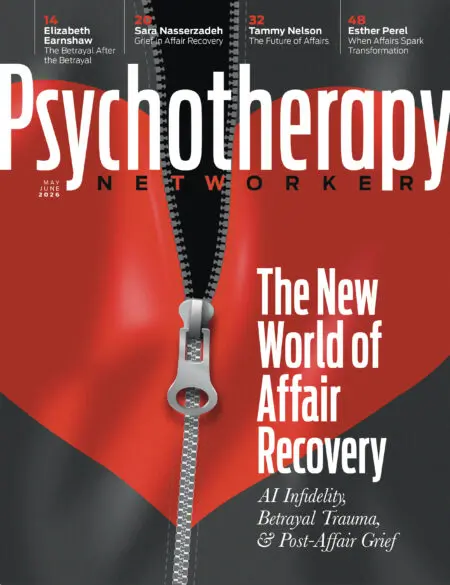
In this issue, well-known couples therapist Elizabeth Earnshaw flags a concerning overcorrection she’s noticed in affair recovery treatment: many clinicians are extending such expansive empathy to the betrayer that the injured partner often leaves therapy feeling doubly betrayed. At the same time, psychosexual therapist Sara Nasserzadeh reminds us that the tidal wave of grief unleashed by an affair doesn’t just belong to the betrayed partner; it reverberates through the entire relational system, and working with that complexity can be a powerful pathway to repair. And relational trauma expert Wayne Baker outlines five concrete, regulating behaviors that rebuild trust after infidelity, because healing isn’t about insight or apology alone; it requires consistent action over time.
Widening the lens further, renowned relationship expert Alexandra Solomon asks us to consider how we treat the often-ignored affair partner in therapy. Internationally acclaimed sex therapist Tammy Nelson challenges assumptions about who has affairs and why, while also exploring the emerging terrain of digital intimacy and AI partners. And bestselling author Esther Perel revisits former clients to discover what separates the couples who ended up thriving after an affair, whether independently or apart, from those still living in the wreckage of infidelity.
There are more articles, too. On betrayal-informed therapy (yes, that’s a thing). On how to discuss prenups in therapy (yes, that’s a clinical conversation). On how systemic trauma can disrupt intimacy with marginalized couples (a different level of betrayal altogether). And on how our minds and bodies can betray us and reshape our relationships, particularly in old age (a reality many of us will face sooner than we’d like).
Will any of these articles achieve the level of notoriety that old, tenacious piece on what to share after an affair still commands? Only time will tell. But for now, these pieces signal a shift in how we’re approaching infidelity these days—one that leaves black-and-white notions of “cuckolds” and “infidels” behind, embraces systemic complexity, and meets clients with regulating tools in the messy reality of healing from relational trauma.

Livia Kent
Livia Kent, MFA, is the editor in chief of Psychotherapy Networker. She worked for 10 years with Rich Simon as managing editor of Psychotherapy Networker, and has collaborated with some of the most influential names in the mental health field on stories that have become widely read articles and bestselling books. She taught writing at American University as well as for various programs around the country. As a bibliotherapist, she’s facilitated therapy groups in Washington, DC-area schools and in the DC prison system. In 2020, she was named one of Folio Magazine’s Top Women in Media “Change-Makers.” She’s the recipient of Roux Magazine‘s Editor’s Choice Award, The Ledge Magazine‘s National Fiction Award, and American University’s Myra Sklarew Award for Original Novel.