As a child, I loved water. I was obsessed with The Little Mermaid and fantasized about building a life under the sea. But summer pools were a sensory storm: shrieking kids, cold water splashing in unexpected bursts, glaring sun, asphalt lava under my bare feet. I wanted to swim, but the chaos was overwhelming.
So I found a workaround. I’d sink to the bottom of the pool, eyes closed, sitting cross-legged for as long as my lungs would allow. Down there, the world quieted. Sounds dulled, the sun’s glare couldn’t reach me, time slowed. Under the water, I could breathe, in a manner of speaking.
When my lungs began to burn, I’d float back up, needing to take in air but also dreading the chaos above. Underwater was still, predictable, and peaceful, but I couldn’t live there. I wasn’t, in fact, the Little Mermaid, and I couldn’t build a world down there. So I learned to hold my breath.
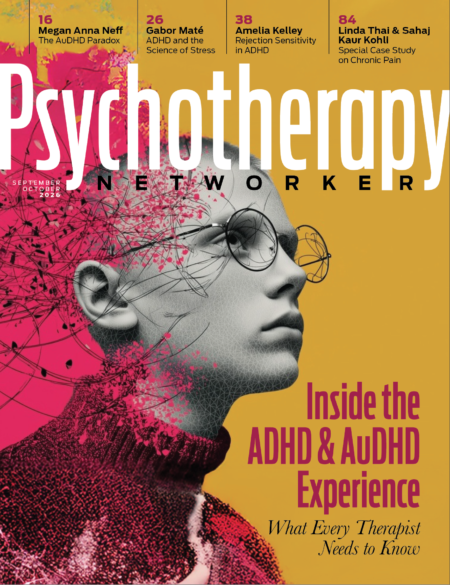
Throughout my life, I’ve had many narratives to explain my inner experience, many of them unkind. The language that’s finally helped me make sense of it is AuDHD. That underwater space is what deep AuDHD hyperfocus and flow feel like. When I’m in it, the noise of the world fades, my thoughts line up, and I can think, feel, and just be.
The moment I’m forced to surface (by a notification, a task switch, a loud room, a demand I didn’t plan for), it all hits at once: the brightness, the noise of external demands, the pressure of task switching, and the internal noise, too. The ADHD pinging starts firing the second I lose the steady line of deep focus, with thoughts rushing in, my mind jumping ahead of me, everything moving too fast and feeling like too much.
This, for me, is the core experience of AuDHD. In the right environment and in our flow state, we find a warm cocoon that makes life feel livable. Unfortunately, to fall into deep, monotropic focus requires ideal sensory conditions and space that doesn’t fit with modern life, which asks us to navigate unpredictable sensory environments, unstructured social experiences, constant task switching, and so much noise.
Under these conditions, autistic sensory overwhelm and ADHD ping-stress collide with each other, and the more they collide, the more we get pushed back into internal cocoons where it’s safe, albeit isolated. That ebb and flow—between trying to engage life in a way that’s livable and retreating to a version that soothes—has been one of the constant tensions of my life.
Many AuDHDers know this tension well: the need to isolate and go deep within oneself to cope while also needing to come up for air and function in a world that asks for more than we can sustainably give.
More Than Autism Plus ADHD
So what is AuDHD? It’s a community-created term that captures the experience of being both Autistic and ADHD. There’s still some debate among researchers and clinicians, but the growing view is that AuDHD isn’t simply ADHD plus Autism (think of a chocolate-and-vanilla cake with the two flavors layered on top of each other), but its own distinct neurology with its own signature—more like a swirl cake, where the two flavors create a third taste that isn’t quite either one. Part of why it’s diagnostically tricky to spot is exactly that swirl: it’s harder to detect the chocolate or the vanilla when they’ve blended. And it’s that blended third taste where what I call the AuDHD paradoxology lives: the push and pull of two neurologies addressing different needs at different times.
The swirl is also why so many AuDHD adults arrive in our offices undiagnosed or partially diagnosed. Autism and ADHD co-occur more often than the diagnostic categories let on. Research estimates that roughly 30–80 percent of Autistic people also meet criteria for ADHD, and 20–50 percent of people diagnosed with ADHD also meet criteria for autism. Until the DSM-5 was published in 2013, clinicians weren’t formally allowed to diagnose the two together, which means a whole generation of us trained in a system that made AuDHD literally impossible to name.
Both autism and ADHD are missed more often in girls and women, in people with high IQs, and in Black and Brown communities. We’re also living through a wave of new understanding of autistic and ADHD camouflaging and masking—the work of suppressing neurodivergent traits to appear more allistic or to fit into neuronormative expectations. In other words, there’s a lost generation of Autistic and ADHD adults who’ve been in our therapy rooms for years and are only now beginning to be recognized.
As if identifying ADHD or autism in adults with non-stereotypical presentations weren’t challenging enough, AuDHD adds another layer of complication. When ADHD is identified first, it’s been shown to delay the recognition of autism. In a 2018 study, children who received an ADHD diagnosis before autism were identified as Autistic about 1.8 years later, on average, than children whose autism was recognized from the start. For girls, the gap stretched closer to 2.6 years. And because racialized children, particularly Black and Brown children, are less likely to receive timely diagnoses of either and more likely to be misdiagnosed, their AuDHD delay may stretch further still.
In adults, the same overshadowing shows up in our therapy rooms. Autistic sensory overload gets read as ADHD overwhelm or as emotion dysregulation, and predictability needs stay invisible. Executive function struggles get filed entirely under ADHD, missing the bottom-up processing piece. A meltdown around a schedule change gets labeled “emotional reactivity” rather than an Autistic person meeting sudden disruption. Sensory seeking gets read as hyperactivity. Special interests get folded into ADHD hyperfocus, missing what the interest is doing for the person. And autistic social differences—literal communication, direct interaction style, hyposensitivity to unspoken context—get folded into ADHD impulsivity and inattention.
When this happens, years of ADHD-only strategies (which often don’t account for sensory safety or transition scaffolding) and years of accommodations that target attention but not predictability needs translate into years of “I should be able to do this,” when the supports were never designed for the wiring underneath. By the time AuDHD comes into the conversation, many of our clients have absorbed a story about themselves built around the wrong frame, and we end up working with that story as much as we’re working with their actual experience.
When ADHD is on the chart and something doesn’t quite fit, autism is worth asking about, especially in adults whose presentation doesn’t match the stereotype most of us trained on.
Eight AuDHD Paradoxologies
As part of an upcoming book I’m writing on AuDHD, I’ve surveyed more than 3,200 AuDHD-identified adults across a series of community surveys. In one of these, 681 adults described where they felt the most intense internal push-pull. The 18 themes that emerged show up as a tangled web, and cluster into five broader domains: executive, social, sensory, structural, and identity.
Often one side of a paradox is doing autistic work: protecting from overwhelm, holding predictability, going deep. The other is doing ADHD work: chasing the next spark of interest, following creative associations, going wide. The two systems aren’t exactly arguing with each other, even though it often feels like they are. They’re addressing different needs, and both are in the service of keeping us alive. Here are eight paradoxes that surfaced most often along with some of the ways they show up in the therapy room.
Perfectionism, Ideas, and an Inability to Execute. For many AuDHDers, the elaborate project lives in our heads in vivid detail: the book we’d write, the room we’d reorganize, the holistic plan to improve our health. The project is detailed, often perfectionistic. And then months or years pass without us starting it.
This was the most common tension our community named, with 34 percent of respondents describing some version of it. The autistic system generates detailed, often perfectionistic plans, and the ADHD system struggles to initiate, sequence, and finish them. One respondent called it “the old ‘unmet potential’… wonderful creative ideas and then not being able to hold onto them, break them down and see them through.” Many of us build core schemas around this gap, knowing we should be capable of doing the thing and experiencing deep shame when we can’t build momentum.
Clinically, this often shows up as a client describing avoidance, low motivation, poor self-trust, or what looks like perfectionism—needing every condition to be “just right” before starting. The elaboration of the plan itself is part of what pins the person down: the more detailed the vision, the harder the first move becomes.
Appearing Fine While Internally Struggling. Another paradox that many AuDHD adults know well is the double mask. We hold it together at the meeting, in the email, in the school pickup line. We laugh at the right beats, hide the panic, and then collapse the moment the door closes behind us.
Twenty-seven percent of survey respondents named some version of the double mask: Autistic social camouflage layered with ADHD compensation. The Autistic side is doing the work of suppressing stims, scripting responses, tracking facial expressions, and modulating tone, while the ADHD side handles a different arena: pretending to follow along when attention has wandered, over-preparing for visible moments to appear competent, or hiding mistakes in front of others for fear of judgement.
To people who know us casually, we look capable, funny, articulate, fine. Underneath, two performances of safety are running, and they’re exhausting. Beyond being exhausting, both masks function to hide the intensity of struggle. That gap between how the mask is interpreted and the struggle being hidden creates a cognitive dissonance for the person living it, and for the therapist trying to understand what they’re hearing. Respondents who were also gender-expansive, trans, or BIPOC named the compounding load of the AuDHD double mask alongside code-switching or gender masking, which means three or four performances of safety running simultaneously.
In the therapy room, these clients can be slow to open up. The same skills that have kept them safe in workplaces and families also keep them at a careful distance from other people, and the mask doesn’t drop just because they’re told it’s a “safe space.” These people have learned that their authentic selves get them in trouble, and that acceptance comes through hiding who they are. Truly feeling safe enough to show up as themselves takes time, attunement, and the ongoing experience of being read accurately.
Longing for Social Connection While Socially Exhausted. Many of us crave the experience of belonging deeply, and we also know that a two-hour gathering will cost us three days of recovery. So perhaps we say yes and then dread the date as it approaches. Or we say no and then mourn what we’ve missed.
A quarter of survey respondents described some version of this. The ADHD side reaches for stimulation, novelty, and emotional contact, while the Autistic side gets quickly overwhelmed by the unpredictability and sensory demands of socializing. What emerges isn’t a lack of social interest, which was the older clinical framing for autism; rather, it’s someone who experiences rapid social depletion.
The other current in this paradox is cost versus reward. Socializing is high-cost for AuDHDers, energetically and sensorially, and the reward for that high-cost activity isn’t always worth it. Many of us carry a long history of social experiences that didn’t go well: critique of our impulsivity, missed allistic social cues, invalidation, rejection. Over time, this negative reinforcement erodes what I think of as social hope—the underlying belief that connection and belonging are findable. Clinically, this often shows up as diffuse social struggle alongside core beliefs that either the self is fundamentally wrong or the world is fundamentally unsafe.
Sensory Overwhelm and Sensory Seeking. Many of us have what appear to be contradictory sensory instincts.We turn the music up to think but we can’t hear ourselves think over the running tap. We need the weighted blanket to sleep and the weighted blanket is too hot.
The AuDHD sensory system often lives in two contradictory states at once. Twenty-three percent of survey respondents named this pattern: needing loud music to focus while being unable to tolerate background conversation, craving deep pressure while flinching from light touch, or swinging moment to moment between under- and overstimulation. The ADHD nervous system reaches for input to increase arousal (I’ve come to think of ADHD as a dysregulation of arousal as much as a dysregulation of attention, with the system reaching for stimulation to avoid being locked into hypoarousal and boredom). The Autistic nervous system, in contrast, has lower thresholds for overload and a higher need for predictable, reduced input. The AuDHD body is constantly reaching for the just-right Goldilocks window of stimulation: enough to feel engaged, not so much that it tips into overwhelm.
When this isn’t understood through a sensory lens, it often shows up as an existential and bodily ache, a restlessness, a fight to get comfortable in one’s own skin. It can present as food or substance misuse, where the person is trying to stimulus-seek and sensory-block at the same time. It can look like someone living in a chronically traumatized nervous system, because in fact they are: enduring and navigating real sensory trauma without language for it.
Needing Routine and Seeking Novelty. This paradox lives adjacently to the sensory one. The ADHD novelty-craving is seeking stimulus to feel alive, and the autism is craving sameness to feel grounded in that life.
Seventeen percent of survey respondents named this paradox directly. The ADHD system runs on novelty: newness flips the dopamine switch and makes engagement possible. The Autistic system runs best on predictability: sameness reduces arousal, decreases prediction errors, lowers sensory load, and tells the body it’s safe to come down from the hypervigilance. While these two impulses look contradictory, they actually aren’t. They’re two solutions to two different needs. Novelty makes us feel alive. Predictability lets us stay grounded in that aliveness.
Clinically, this can look like inconsistency or “they don’t know what they want.” It can also show up as wanting structure and resisting it at the same time, asking for routine then struggling to stick with it, or protesting the constraints of the routine. The client who insists on the same coffee shop every Tuesday and also quits their job to move across the country isn’t being contradictory. They’re feeding two different parts of the system, and part of the work is helping them notice which needs get neglected when others are fulfilled.
High Competence and Basic Dysfunction. At work, I look organized. Behind closed doors, my bathroom sink is littered with half-finished coffee cups, some forgotten long enough to grow mold. I can present eloquently at conferences and then come home, crash on the couch for three days, and find it hard to speak. I can spend 10 hours writing this article about AuDHD while struggling to take five minutes to log into my health portal and reorder ADHD medication.
Twenty-two percent of survey respondents described some version of this gap: being seen as capable or even exceptional in some areas, while spectacularly failing at tasks others treat as routine. Special interests and hyperfocus open up islands of unusual performance, while executive dysfunction and sensory demand make ordinary tasks hard. This visible contrast tends to erode our credibility when we ask for support.
Clinically, these clients often wonder what’s wrong with them. If their values were in the right place, the story goes, they’d care more, and if they cared more, they’d be better parents, partners, and humans. Part of the work is interrupting that story and helping the person see that this isn’t a failure of character: it’s about a mismatch between brain architecture and the environment.
Wired and Tired. Here’s another common scenario many of us know: It’s 2 a.m. We’re tired. We’re awake. The brain is still pinging even while the body aches from fatigue. The mind has produced four new project ideas, a to do list, and a memory of something embarrassing from 2003.
One in five respondents described a mind that can’t rest on top of energy reserves that are perpetually empty. Autistic people tend to need a lot of rest, because the work of camouflaging, sensory overload, and navigating unclear expectations takes enormous energy, and many of us experience autistic burnout when we’ve been doing too much with too little support for too long. ADHDers can also experience burnout, with our hyperfocus bursts tending to be followed by crashes. And ADHD can make it hard to rest in ways the world recognizes as rest. Boredom can feel like a deep ache; I call it the “I want to crawl out of my skin” feeling. Finding the balance between rest and stimulation is one of the harder navigations in an AuDHD body.
The autonomic system ends up stuck somewhere that’s neither fight-flight nor rest-digest—a dysregulated middle ground. Clinically, this is often where we see chronic insomnia coexisting with chronic fatigue, and the kind of low-grade dysregulation that doesn’t fit cleanly into anxiety or depression while borrowing the worst of both. The pattern intensifies in burnout, exactly when we need it not to.
Feeling Too Much and Too Little. Our experience of emotion is also fertile ground for the AuDHD paradoxology. Sometimes the emotion comes in hot, and we’re reacting before we can register what hit us. Then there are days we feel flat, unmoved, watching ourselves from behind a thick pane of glass. Autistic emotional processing collides with ADHD emotional flooding, and a nervous system that’s already carrying a chronic sensory and social load doesn’t have much room to downregulate.
Many Autistic people experience delayed emotional processing and need time and space to find the words for what we’re feeling. We also experience alexithymia (as do ADHDers, but to a lesser extent), meaning difficulty identifying or naming our own emotions, which can lead to emotional suppression or minimization while we take the cognitive time to process. ADHD, on the other hand, is associated with emotional dysregulation tied to impulsivity, a brain that struggles to hit the brakes, and rejection sensitivity dysphoria (RSD)—closer to emotional maximization and externalizing emotions.
An AuDHD person may tend toward one of these emotional profiles, or oscillate between feeling everything (sometimes catastrophically, often with RSD as the accelerant) and feeling nothing (sometimes for days or longer stretches of burnout). We also feel big things over small things (routine disruptions) and small things over big things (loss and grief).
Clinically, this can be the client whose emotional world looks explosive or chaotic, or the one who’s highly rational and intellectual about emotion while describing intense moments of losing control. It can be the client whose intensity in session is disorienting to sit with. The work tends to involve gradually expanding the window of tolerance, somatic regulation followed by emotional naming, and a steady, predictable therapeutic presence that creates space for the whole spectrum of feeling.
Not every AuDHDer will see themselves in all eight of these paradoxologies, and some will identify more with some than others. My survey respondents skew toward a particular slice of the community: Autistic adults with lower traditional support needs but high mental health needs, aged 30-60, with the literacy and access to complete a long online survey. The push-pulls I’ve described are common threads throughout the community, but the way they show up in clients will be shaped by demographics, support context, gender, race, class, and life stage.
And there’s an added twist: for most AuDHDers, these paradoxes are only part of the clinical picture.
AuDHD and Alphabet Soup
Complicating things for mental health providers, many AuDHDers live with a handful of sidekicks that accompany these paradoxes. In our community, we sometimes lovingly refer to this as our “alphabet soup.” For me it looks like OCD (I’ve ebbed and flowed out of meeting diagnostic criteria throughout my life), PTSD (recovered), anxiety, and bipolar 2 (which was originally misidentified as depression).
The DSM would have these things live in neat categories and checkboxes, but AuDHDers lived experience isn’t so neat, and neither is treatment. Many AuDHD people live with mental health conditions whose symptoms breed off and feed off what I call neurodivergent woundings: the organic harm that comes from being AuDHD in a world that often misunderstands us.
For example, when I struggle to remember a deadline, my keys, my phone, or whether I turned off the stove (thanks to executive function and working memory challenges), it’s easy to grow anxious about what I might be forgetting and whether someone will be upset with me. It becomes hard to trust my memory, and that mistrust creates fertile ground for more anxiety to grow. CBT or other anxiety approaches that don’t honor the AuDHD soil my anxiety has grown from will only get so far in helping me manage it. What I need is an approach that treats my anxiety as partly accurate and helps me tease apart which parts are which. For the anxiety that points to an underlying neurodivergent need, what helps is external scaffolding and accommodations that support my working memory (alarms, visual cues, lists). For the anxiety that has taken on a life of its own, what helps is mindfully noticing and unhooking the scripts while mapping them onto the core wound or raw spot they’re bumping into (a mixture of meta-awareness, mindfulness, and parts work).
When my energy system goes from excited bursts (fueled by interest and novelty) into collapse because I’ve burned out in a hyperfocus spell, I lose interest, curiosity, energy, and yes, happiness. The depression that takes root after I’ve lost access to my interest-based nervous system has a different shape than classic depression, and treating it the same way will only deepen the collapse (behavioral activation, for instance, can re-trigger the very depletion that started the slide). What’s needed instead is gentle structure, nourishment, time with special interests, and strategic social withdrawal. I need help recognizing when my withdrawal has tipped from restorative to something feeding the depressive cycle. For an interest-based nervous system, interest isn’t the reward for getting better. It’s often the way back.
When my scrupulosity OCD rages, it usually comes from the context of having misstepped socially (scrupulosity is a subtype of OCD characterized by intrusive thoughts and compulsions related to ethical, moral, or religious concerns.) I’ve lost relationships, been chastised and punished, and even fired for the way I managed situations I didn’t understand. But my lack of understanding hasn’t done much to mitigate my shame and sense of culpability. When the world is uncertain and social norms are hard to decipher, OCD scrupulosity comes in as a way to manage rules I can’t otherwise read. How can we treat the OCD if we don’t know what it’s trying to protect against?
For years I walked through life in a foggy, dreamlike state. I explored with my therapist whether this dreaminess was repressed trauma. Why did I lose myself constantly, feel as if I were experiencing life from behind plexiglass? Without factoring in my sensory awareness issues as part of the clinical picture, the only available lenses I had were anxiety and trauma, and so I continued to disappear from my life rather than understanding my sensory shutdown.
Toward AuDHD Self-Understanding
The unfortunate reality is that AuDHD people fall through the cracks easily—and it’s not because of bad therapists. Fortunately, we’re living through a season of great discovery, and a whole generation of adults who were labeled “depressed,” “anxious,” “OCD,” or “BPD” are beginning to recognize their full neurological context. Naming AuDHD doesn’t magically fix the challenges we live with, and it usually doesn’t change the felt experience of the push-pulls we navigate. But it offers context, and context is what so many of us have been missing for so long.
The first healing direction is often inward. Naming AuDHD helps us shed old shame-based narratives and build new ones. We start to see that we (our emotions, our experiences, our nervous systems) make sense in context. The shame-filled stories begin to loosen as we identify and validate our AuDHD needs. That shift from shame to self-compassion is where a lot of other psychological work becomes possible.
The second direction is outward. AuDHD reshapes what we understand about our needs and what kinds of support help. We can start to build ADHD scaffolding (external structure, reminders, flexible accountability) alongside autistic-centered care (sensory safety, transition scaffolding, predictability in relationships and environments). For those of us in clinical work, the invitation is similar: create space for the complexity and treat the push-pulls our clients describe as paradoxes rather than inconsistencies to be solved or analyzed away.
An AuDHD life often mirrors my experience in that swimming pool where I used to imagine being the Little Mermaid: serenity below, chaos above. Our work helps people learn to swim between the depths and the surface with less shame, gently noticing, over time, that the dives themselves, however protective, can’t carry the weight of life on their own.
Megan Anna Neff
Megan Anna Neff (she/they), PhD, is an AuDHD clinical psychologist, as well as the author of Self-Care for Autistic People, The Autistic Burnout Workbook, and the forthcoming AuDHD Unlocked (Spring 2027). She’s the founder of Neurodivergent Insights, the business behind her education, training, clinical writing, and the NDI YouTube channel. Grounded in the blend of clinical insight, research, and lived AuDHD experience, NDI translates complex neurodivergent experiences into accessible, compassionate, and affirming resources for adults, clinicians and helping professionals worldwide.