
Enjoy the audio preview version of this article—perfect for listening on the go.
Whenever we prepare an issue on a clinical theme, we search our archives for pieces that offer enduring insights. And given that we’ve been around since 1978, we have a rich trove of clinical wisdom to draw from. For this issue, as we explored articles on affairs and infidelity, we noticed something unusual. The evolution of affair recovery treatment hasn’t followed a linear progression from disproven practices to accepted ones. Instead, it’s a tapestry of perspectives, clinical dilemmas, and paradigm shifts. And it’s also an area where time-specific clinical assumptions—about roles in society, heteronormativity, the implicit value of commitment, who’s responsible for what in a relationship—become more starkly (and sometimes embarrassingly) visible, once blind spots have cleared and mores have softened.
Although many of the following excerpts still speak to contemporary practice, they’ll likely give you pause and invite reflection on the evolution of our field. The language itself shifts across decades—from “victim,” “cuckold,” and “infidel” in the late ‘80s and early ‘90s to “betrayed partner” and “unfaithful partner” by the 2000s. Debates about responsibility, power, and gender gradually broaden the lens to include larger systems, while trauma-informed approaches take root and deepen our understanding of betrayal’s physiological and emotional impact. Fundamental questions also remain unsettled: When, how, and under what conditions should betrayed partners get information? Is betrayal always traumatic? Must affairs end for couples work to begin?
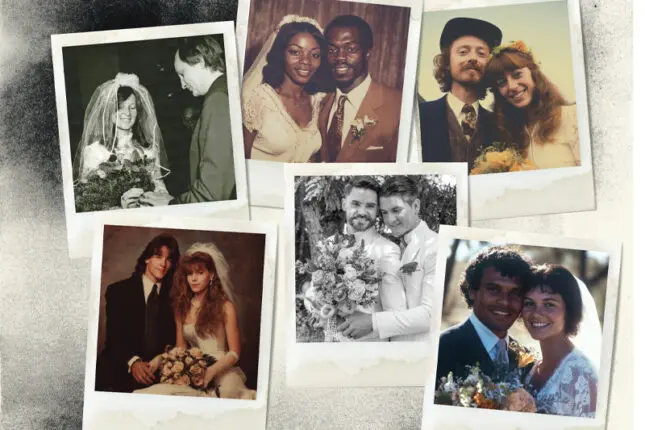
Organized chronologically, these excerpts offer a slice of infidelity treatment history. A chance to catch glimpses of what lasted, what didn’t, and perhaps even to hold some of our prized contemporary clinical-certainties-du-jour with a little more humility. There’s something clarifying—even when we experience a jolt of surprise—about looking back at where we’ve been, the way an old photo can reveal not just how we looked in neon leg warmers or sporting a mullet, but how we saw the world. So, if some of this makes you cringe a bit, you’re not alone. Here and there, we cringed a bit, too.
“Contrary to common belief, the victim’s rage doesn’t focus on the extramarital sex. Even if he has convinced her that there was no sex, she is still furious—shocked and angered by both his secrecy and her own gullibility. She is deeply grieved by her husband’s intimacy with someone else—intimacy that she believed was hers alone. The infidel is by turns silent, apologetic, defensive, protective of the other woman, and ambivalent about the marriage. He finds his wife’s anger threatening and repellent. Her rage can indeed take on majestic proportions, but until she feels it rightfully acknowledged by both husband and therapist, no other marital issues can be productively explored.”
“What people don’t know can hurt them—and what they don’t reveal can hurt them even more. Secrets can destroy lives and relationships. When something is kept secret, it can grow in power and significance until it becomes the center of one’s identity. Fed by fear and shame, secrets thrive in the dark. People hiding with their secrets may shrink from intimacy, believing they would never be loved if their secrets were known.”
“The devastating destructiveness of infidelity is not primarily because the private act of sex has been shared with an outsider, but because the intimacy of the previously bonded relationship has been betrayed by the secret and the lie of the infidelity.”
“When therapists assume their clients are fragile and all family relationships are treacherous, they urge caution about honesty and intimacy. When they do so, they send the terrifying message that the client’s secrets really are that horrifying, that the client really would be rejected if the secrets were known, and that intimacy is not possible for one with such a secret. Such therapists, as they increase their clients’ shame and alienation, tell us they are guarding their clients’ privacy.”
“Some therapists don’t take strong stands against affairs, dishonesty or the continuation of any relationship with the affairee who intruded the marriage. Many believe affairs are caused by imperfect marriages, and that the cuckold, who wasn’t even there, must share the responsibility for it.”
“I made it clear that I saw Ed’s decision to have an affair as his responsibility and his alone, that if he was unhappy in his marriage, there were other options, like asking Linda to go for professional help. At the same time, I emphasized that the problems in the marriage were Ed and Linda’s joint responsibility, and that they both had to look at their own parts in creating them. Both of these statements were pivotal in my approach. It is crucial to avoid misunderstandings about the concept of responsibility, and about where I stand on it.”
“First, I would assess the distribution of power between wife and husband. As they come together to renegotiate the terms of their marriage, do Ed and Linda come as equals with equal money, equal ability to know and state their desires, an equal stake in the marriage? Usually, compared with her husband, the wife has less money she regards as her own and feels less entitled to set forth terms for the relationship. Typically, she has a greater stake in the survival of the marriage because divorce imposes a greater financial, social and parental burden on her than on him.”
“’Linda, if I ask you how sex is for you with Ed, how would I know if you were answering me with a good wife voice, a scared voice or your own voice?’
‘Ed, how do you tell whether Linda is having sex with you as a kindness to you, out of fear of losing you or out of her own desire? Do you care which it is?’”
“Discovering that a partner’s been unfaithful is a traumatic event that shatters all the basic assumptions of commitment, love, and honesty. Under-standing the story of what happened is an essential part of the recovery from that trauma. In most cases, the betrayed partner’s demand for information isn’t meant to divert discussion away from marital problems (as some clinicians have suggested) but to put the pieces together into a meaningful whole. In fact, research has consistently shown that individual recovery, survival of the marriage, and restored trust are contingent on honest communication about the infidelity.”
“The best resolution of infidelity is achieved when both partners assume responsibility for improving the relationship and are able to co-construct a story of the affair that integrates their different perspectives.”
“My approach to affairs is heavily influenced by the work of clinician–researchers Douglas Snyder, Donald Baucom, and Kristina Coop Gordon, who advocate that partners go through a three-phase process: (1) focus on self-care, slow down the process, and do no harm to each other; (2) make personal and relational meaning of the affair; and (3) decide to either recommit to the marriage or achieve a ‘good divorce.’ In my work, I emphasize an additional phase: sexual recovery from the extramarital affair. Few theoretical and clinical models include this vital aspect of treatment.”
“This larger focus on the couple’s marriage and sexual connection enabled them to begin addressing the fuller meaning of the affair. Until then, it was as though Justin and Cheryl had been speaking completely different languages about the affair’s significance, and now finally were able to communicate in English.”
“I tell them that if a betrayed spouse needs to talk about intense feelings or the facts surrounding the infidelity, then that has to happen; this step simply can’t be bypassed. Even if it’s uncomfortable for the unfaithful spouse, it doesn’t matter; he or she needs to be coached to answer questions openly and honestly. Unfaithful partners often benefit from some individual work if shame is preventing them from being compassionate, empathetic, and emotionally available to their spouses. They also need to be reminded of the importance of sharing the whole truth, rather than allowing the information to leak out in piecemeal fashion. Facts about the affair that surface long after the initial discovery are, without question, retraumatizing for the betrayed spouse, and they can trigger major (and sometimes irreparable) setbacks.”
“When betrayed spouses ask, ‘Will this knot in my stomach ever go away?’ or ‘Will there ever be a day when I won’t wake up thinking about the affair?’ I’ve seen how helpful it is to reply with conviction, ‘You’ll never forget what happened (nor should you), but eventually, you’ll think about the affair less and less, and when you do think about it, the memory won’t carry the same emotional charge as it does right now. I promise that will be the case.’”
“The myth of therapist neutrality was first exposed back in the 1970s, when feminist therapists noted how many clinicians looked the other way when women got the short end of the relationship stick. But the therapy field has been slow to deal with a broader implication: that many issues clients bring to therapists have ethical dimensions, and that clients often struggle with ethical dilemmas, or situations in which their actions have consequences for the well-being of others. I use the term ethical consultation for the intentional and skillful exploration of these ethical dilemmas in a session—as opposed to simplistic exhortations by therapists to either ‘do what feels right to you’ or ‘do the right thing.’”
“And then there’s the issue of emotional affairs. During my training, we didn’t have a clear concept of marriage-threatening relationships that were not sexual. Nowadays, there’s lay and professional awareness that married people can get into close relationships that undermine their primary relationship without being explicitly sexual. In many cases, the people involved tell themselves that it’s not cheating on their spouse. But the effect on the spouse and the marriage can be similar when the other relationship becomes emotionally more salient and rewarding than the primary relationship—or when the other person becomes a competitor with the spouse in other ways without the spouse knowing it. In addition to entering a relationship that can threaten marital commitment, the main ethical dimension of emotional affairs comes in the form of lies and secrecy about the existence or importance of the other relationship.”
“I never suggest that the factors that led to the affair are a full justification for the affair. I frame them as influences and risk factors (such as a midlife crisis related to job loss and plummeting self-esteem), but not as determinants. The same goes for a sexless marriage: it’s certainly a predisposing factor, but there are other ways to deal with the problem. It’s important that the therapist not accept that the client has no agency about the affair: it’s a choice among several possible choices.”
“Psychotherapy is sapped of healing power if it ignores this ethical dimension of our clients’ lives. There’s no separating psychological well-being from the client’s experience of ethical integrity.”