
Enjoy the audio preview version of this article—perfect for listening on the go.
I recall being in my mid-twenties and at the beginning of my own healing journey, attending therapy for the first time and joining a twelve-step program to try to get a handle on my very destructive food addiction. This was before I decided to become a therapist myself. I was at the stage of change when the caterpillar turns into a mushy mess in its cocoon, unable to conceive of ever becoming a butterfly. The feeling that had lodged in the center of my soul as a child, and which remained in me well into my adulthood, was that I was an orphan. Now, I wasn’t technically an orphan, but it’s how I felt. During the early years of my healing journey, I frequently listened to Mahalia Jackson singing “Sometimes I Feel Like a Motherless Child,” tears streaming down my face, grieving a past where I’d felt unloved, unwanted, and uncared for.
I got a lot of validation for this story from many compassionate friends, sponsors, healers, coaches, and therapists. I’m grateful I did, for their kindness helped me process the pain I was in. Yet once I began taking responsibility for myself as the source of my experience, I began to question my certainty about how things went down.
It began one day when I overheard my mother telling a neighbor that when I left home at the age of 18, it broke her heart. Now that surprised me because my recollection was that I was thrown out of the house because I refused to go to college. In fact, being a “throwaway” was an integral part of my story, and I’d been wearing it like a badge of honor for years. Yet my mother’s version of the story, and the sincerity with which she told it, made me question my own, and wear it more loosely.
Inside of the story that I was an emotional orphan I felt a deep and pervasive sense of aloneness in life. While I stayed in contact with my parents in a polite sort of way—exchanging Christmas gifts through the mail, sending birthday cards, and taking the occasional trip across the country for a brief visit, I don’t believe I ever felt very connected or cared for even as an adult. That sense of alienation from my roots created a feeling of being lost in the world, as though I didn’t quite belong anywhere or to anyone. It wasn’t until many years later when I challenged the certainty of that false center story that my relationship with my parents began to change. I’d always assumed that they were the source of the story, that it was true I wasn’t loved or wanted. Yet in stepping outside of my orphan identity and no longer generating my relationship with them from that center, I discovered just the opposite—that they were actually eager to know, include, and care for me.
It was confusing at first, because I’d been so sure that the story was grounded in fact, when actually I saw that I myself had been generating our estrangement in a thousand little ways—by being guarded and defensive when we spoke, rarely asking for their support, failing to invite them to attend the important events of my life, or covertly judging them for the choices they’d made in their lives. The list goes on and on. The choice to start showing up in ways that consciously created the possibility of greater connection, rather than continue indulging the habit of distance between us, made all the difference. Now we are all quite close and loving, and no one who sees us together would ever believe we spent decades feeling disconnected from one another. That’s the power of releasing the certainty of our victimization and making the choice to create a new story.
Executive coach Deanna Moffitt tells a similar story. I met Deanna when she attended one of my courses, where she generously shared about her strained and emotionally challenging relationship with her aging mother—a woman she resented strongly, in spite of the years she’d spent working on their relationship. Deanna’s main complaint was that she continually felt invisible, particularly when trying to share childhood experiences she was hoping to heal. In response to sharing her feelings, her mother would become prickly and defensive, as if her memory of herself as a good and loving mother was suddenly under attack. As Deanna had been adopted at birth, she felt the double unfairness of a birth mother who’d rejected her and an adoptive mother who refused to see and hear her. I told Deanna she had what I call an upside-down hierarchy. Meaning that the one with the least amount of psychological and emotional development was the person in charge of the dynamic between them.
As Deanna had been working on herself for years, she was actually the one who needed to be the leader of their connection and not the other way around. After taking that in, Deanna could see that by continually pulling on her mother to validate her experience—a capacity her mother clearly did not possess—she was reinforcing her “I’m invisible, no one cares about my feelings and needs, and it’s dangerous to reveal my true self” story, setting herself up to be re-wounded again and again. Yet by choosing to be the leader of love in their relationship—generating love, as opposed to trying constantly to get it—Deanna could develop compassion for her mother’s inability to see her, recognizing it as an indication of her mother’s own need to be seen as she wanted to be seen.
As Deanna worked to accept her mother for who she was, and who she wasn’t, she found herself enjoying her mother’s company. As fate would have it, her mother became ill soon after and Deanna was able to show up in a loving and supportive way to care for her. Eventually, the two women became so close that her mother confessed that Deanna was her best friend in all the world. They now talk daily, not out of obligation, but simply because the love between them is so strong.
This is what it is to be a creator of life—someone with the spiritual strength, as well as the agency, to actively generate the future they desire—rather than stuck in reaction to life. Have others behaved badly over the years? Most certainly they have. Have you yourself made terrible mistakes, the consequences of which you’re still living with today? Probably, yes. Has life itself been difficult, unfair, and even unkind? For many of us, yes it has.
We can stay mad at our parents, at our teachers, at our older siblings, at the circumstances of life that originally caused us to drop into that false center. We can feel victimized. But until you recognize that you yourself are now the one who is perpetuating the story inside of habitual ways of relating, you will not graduate from that story. I don’t care how much you understand it. I don’t care how much you’ve grieved your past. You are the creator of your experience—and you are generating your experience continually. The choice to stay generative of a positive, possible future in the face of all of life’s challenges is what it is to be a mature force for love in this world.
While healing requires we look backward, transformation requires we lean in, listen for, and live into a positive, possible future. There’s a time to grieve the pain of the past. To connect the dots between what happened way back then and the patterns we struggle with today. Yet for those of us who’ve been working on ourselves for a while now, the time of focusing solely on the past in order to change our lives for the better has passed.
Now we have the choice to be a person who lives from creativity, from wisdom, and from goodness in the face of all of life’s challenges, and who continues to act in alignment with a positive, possible future—that’s what it is to begin to really step into your power as a creator of life. Deanna chose to be a force for love in her relationship with her mother, and that made all the difference.
Expanding Your Circle of Care
Ultimately, life has a way of bringing all of us to our knees and waking us up to the importance of surrendering to life on life’s terms. At the end of the day, all we really have is who we choose to be in the face of life’s challenges. Challenges that can occur as deeply disheartening and profoundly unfair.
By my mid-thirties, I’d accomplished little. I’d failed at creating an acting career in spite of graduating from one of the top acting schools in the country. I was struggling as a singer in spite of putting years into mastering the Great American Songbook. I was barely making ends meet by doing odd temp jobs here and there in spite of having a quality (and very expensive) education. I was unhappy with my weight in spite of being on a diet for decades. And my love life was a complete and utter disaster. At the time I was living in Los Angeles—the land of beautiful, successful people all doing fabulous things with their lives—and I was feeling like a complete failure. Yet fortunately, I was also tired of feeling sorry for myself. One day while driving toward the freeway, I made a choice that I now believe to be one of the best decisions I’ve ever made, though I did not know it at the time. I decided that if love wasn’t coming to me, I was going to bring love to others. I simply refused to live a loveless life.
How’s that for an unprecedented future? My motive was simple. Since I knew firsthand the heartbreak of not getting what I wanted in life, I wanted to alleviate that suffering for others. Yet who could I make a difference for? I had zero credentials. The only thing I’d ever really done professionally was wait tables, do temp work, and sing in nightclubs.
As I pondered this question, I passed some homeless people on the freeway on-ramp begging for pocket change. I found myself wondering how I might bring love to these poor people who were even worse off than I was. Soon after, In Harmony with the Homeless was born. It started as a simple idea to create a CD with songs written by people who were homeless, telling their stories through song and giving them a voice. Yet just by putting one foot in front of the other, it eventually became a project that spanned the next five years and involved over a thousand volunteers from the Los Angeles songwriting community, helped over a hundred men and women leave street life behind for good, and was featured in a televised episode of ABC in Concert to coincide with the release of a CD featuring songs cowritten with some of the best songwriters in LA, and with star recording artists like Mavis Staples, Brenda Russell, and Richie Havens performing.
It seemed like such a small, simple choice at the time—to help a few people who were hurting more than I was by giving them some dignity and hope using whatever tools I had available to me at the time. Yet it ended up changing the trajectory of my entire life. While I didn’t create that project to get anything in return, as the saying goes, I ended up receiving so much more than I gave.
For one, it expanded my vision of what was possible in my own life beyond myself. Because of it, I ended up in graduate school to become a therapist. And it was the beginning of my teaching career, which to date has touched hundreds of thousands of lives over the past two decades—writing that still brings tears to my eyes. I don’t think I’ll ever quite get over the miracle of it after such a discouraging start in life. It also helped me to grow my confidence and leadership skills. Which was no small matter as, for a long time, I’d whisper what I wanted to say in the ears of my very extroverted cofounder as we stood in front of a room filled with folks eager to participate in the project. I don’t think anyone even knew what my voice sounded like for two whole years before I finally found the courage to get up and speak what was in my heart to say. It also turned my run of bad luck around.
Within a relatively short period of time, so much of what I’d been trying to create in my own life came to fruition with little effort, and as if by magic. A happy marriage to a lovely man, becoming a first-time mother at the age of forty-three, increasing my income tenfold doing what I loved, buying my dream home, and getting a book deal with virtually no writing experience or platform to speak of—“Calling in ‘The One,’” which became a national bestseller within four months of publication even though I had no idea what I was doing and few resources to launch a book into the world.
I now know firsthand that when it looks like there’s no way out and no hope for a better future, the best thing we can do is to look for and make the choice to expand our circle of care to include others who are suffering, too.
In her book “Living a Committed Life,” Lynne Twist, cofounder of Pachamama Alliance, puts it perfectly: “A commitment larger than your own wants and needs lifts you out of the landscape of your circumstances and personal desires. It lifts you out of day-to-day moods, irritations, and upsets about things not going your way. It pulls you out of that smallness and elevates you to a place where you find the strength and courage to generate your life out of possibility and generosity.”
***
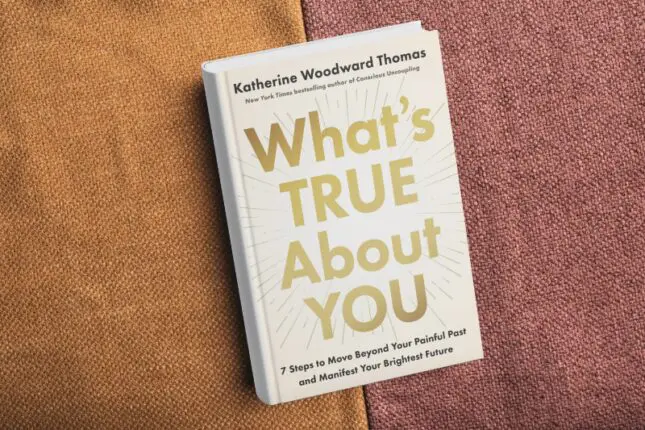
From WHAT’S TRUE ABOUT YOU by Katherine Woodward Thomas, published by Penguin Life, and imprint of Penguin Publishing Group, a division of Penguin Random House, LLC. Copyright © 2026 by Katherine Woodward Thomas.
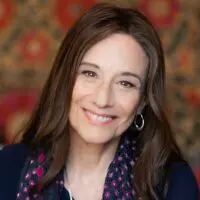
Katherine Woodward Thomas
Katherine Woodward Thomas, MA, MFT, is a licensed therapist and a recognized pioneer in transformational psychology. She is the New York Times bestselling author of Calling in “The One” and Conscious Uncoupling and her newest book, What’s TRUE About YOU. Thomas has taught hundreds of thousands in her virtual and in-person programs, and trained thousands of professionals in her future forward methods.