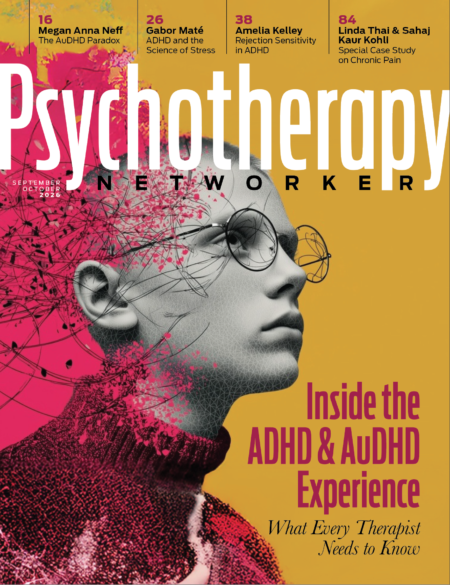
Roughly one in nine American children will be diagnosed with ADHD this year—nearly double the rate from 25 years ago. And yet many parents, teachers, medical professionals, and even clinicians routinely miss the lesser-known signs, the toll it takes on relationships and self-esteem, the mental health consequences, and the very real harm of misdiagnosis. In other words, even though ADHD has entered the mainstream, a nuanced understanding of it has not.
Physician and bestselling author Gabor Maté—best known for books on addiction and trauma, including In the Realm of Hungry Ghosts and The Myth of Normal—has spent decades arguing that the science tells a far more complicated story about ADHD than the one many of us believe. In fact, his first book, Scattered Minds, came into being in large part because Maté himself received a late ADD diagnosis, along with medication that helped him focus enough to write it. Since then, some of his views on ADHD have run counter to conventional wisdom and even sparked controversy.
In the conversation that follows, Maté unpacks the science behind his thinking on the environmental factors that contribute to brain development and ADHD—and shares what it’s taken to make peace with himself as someone who regularly loses laptops on planes without ever leaving his chair.
Psychotherapy Networker: You’re most well-known for your work on trauma and addiction. How did you first get interested in ADHD?
Gabor Maté: I got interested in the subject 27 years ago, when I was diagnosed with ADD. A few months later, so were my kids. It was then I wrote my first book, Scattered Minds: The Origins and Healing of Attention Deficit Disorder. I’d always wanted to write books, but I could never get myself organized enough or motivated enough to do it until I understood my own mind.
I took medication to help me concentrate when I wrote Scattered Minds. I wouldn’t have been able to do it otherwise. I’ve written five books since then, including The Myth of Normal, and didn’t need medication to write them.
What does that mean? It means the brain can change, and this is good news because ADHD is a condition of the brain. It’s a neurodevelopmental disorder. It does have certain biology associated with it, but that biology is responsive to the environment.
PN: People claim that you deny the role of genetics in ADHD. How do you respond to that?
Maté: It’s not true, and only people who haven’t read my work can claim so. In Scattered Minds and other books, I fully discuss the role of genetics. Genes do play a role in all manner of conditions, including ADHD. The question is, what kind of role? And the answer lies in the essential difference between predetermination and predisposition.
Predetermination means that if you have a certain gene, you’ll have that condition—for example, Huntington’s disease or types of muscular dystrophy, such as runs in my own family. And if you don’t, then you won’t. Predisposition means that if you have a certain group of genes, you’re more than likely to develop that condition. Predisposition is not the same as predetermination—genes develop and unfold and express themselves in interaction with the environment.
Russell Barkley, one of the critics of my work on ADHD, has never read my book, as he admitted to me; yet he took it upon himself to critique my work on YouTube. I read his book, Attention- Deficit Hyperactivity Disorder: A Handbook for Diagnosis and Treatment, which he published decades ago. In fact, I quote him in Scattered Minds. He’s done a lot of good research on ADHD, and he reports, for example, on a large 1989 study of twins, both identical twins and fraternal twins. Identical twins have exactly the same genes. Fraternal twins are like any sibling pair: they share some of the same genes but not all of them.
According to the most recent information, if an identical twin has ADHD, their identical twin has a 75 percent chance or higher of also having ADHD. In fraternal twins, there is up to a 30 percent concordance. Now, if ADHD is only genetic, it would be 100 percent concordant. But in fact, those high concordances are an overestimate, since if the twins, whether identical or fraternal, grow up in the same home, there’s no telling what’s environmental and what’s hereditary. This is where adoption studies come in.
PN: Before we get into that, let’s talk a little about what brain development has to do with ADHD.
Maté: There’s no shortage of information on how the brain develops, but I’m going to read you a sentence by Jack Shonkoff and colleagues from an article in the official journal of the American Academy of Pediatrics: “The architecture of the brain is constructed as part of an ongoing process that begins before birth, continues into adulthood and establishes either a sturdy or a fragile foundation for all the health, learning, and behavior that follow.”
The architecture of the brain means the chemistry, the circuitry, the connections, the synapses—and what I just read points to the fact that the brain is already being constructed in the womb. And we know from multiple studies that if a woman is chronically stressed during pregnancy, stress hormones, like adrenaline and cortisol, get through to the baby and affect the development of the brain. When women experience stress during pregnancy—as, through no fault of their own, many do in our troubled culture—their kids have a higher risk of mental health and self-regulation challenges, including ADHD. That’s the first point.
The second point is that a lot of the genetic hypothesis rests on adoption studies. Since the role of intrauterine stress and its impact on the developing brain has been established by multiple studies beyond any valid doubt, even when twins were adopted to different families it’s not true that they had different environments.
Any woman who’s forced to give up her infants for adoption is likely to be stressed. Maybe she’s poor, addicted, an unsupported teen, perhaps even abused. Those twins shared the same stressed womb for nine months, received the same stress hormones which affect the brain. And then, they both experienced the trauma of separation from the birth mother. This is why, when you look at an ADHD population, their chance of having been adopted is exponentially higher. So, as I discuss in Scattered Minds, these oft-cited adoption studies tell us much less than you’d think. And if you want to read an extensive debunking of twin research, see The Trouble with Twin Studies by Jay Joseph.
The third point is that there are 20,000 genes in a human genome. Of those 20,000 genes, about half of them are dedicated to the central nervous system. In the human nervous system, there are about 86 billion nerve cells, or neurons, which form from 100 trillion to 500 trillion connections, or synapses. If you add up all the nerve cells in the human brain and stretched them into one line, it would wrap around the earth 10 or 15 times. There are simply not enough genes to account for the variability of the potential circuitry and connections and unfoldment of the human brain. That all happens in the impact of the environment.
Another sentence from the American Academy of Pediatrics article reads, “The interactions of genes and experiences literally shape the circuitry of the developing brain, and is critically influenced by the mutual responsiveness of adult-child relationships, particularly in the early childhood years.” In other words, it’s not genes by themselves. It’s the experiences acting on the genes, because genes are turned on and off by the environment. You can have the same genes and different environments, and get totally different outcomes.
We know this from monkey studies. Certain monkeys are more prone to being hyper-reactive, and they’re called high reactors. Brought up in a certain way, they’ll be bullied by other monkeys, ostracized, and less capable of self-regulation. Put those same monkeys with what are called “super mothers,” and they become leaders. They become more creative, confident, capable. Same genes, different outcomes based on how the environment is acting on the genes.
Nobody has found any particular gene directly linked to ADHD. What they found is a large group of genes, and the more of them you have, the more likely you are to have any number of mental health conditions, including ADHD or depression or anxiety. As a recent review in The New York Times summed up, scientists at most have identified a “complex collections of genes that together may be signs of greater risk for ADHD.” Notice the “may be.” Far from a predetermination.
In any case, there is nothing we can do about genes. But there is much we can do about the environment. That’s the point I make in Scattered Minds, also echoed in the NYT review: “Rather than trying to treat and resolve the biology, we should be focusing on building environments that improve outcomes and mental health.”
PN: The second part of the sentence from the article you read mentions early childhood relationships in the context of the developing brain, which is a major part of the environmental factor you’ve been talking about, right?
Maté: Yes, the most important influence is the quality of interactions with adults and parents. As the renowned psychiatrist Dan Siegel points out, “Human connections create neuronal connections.” And, as trauma expert Bruce Perry writes, “Developmental experiences determine the organizational and functional status of the mature brain.”
What’s happening in this culture and the reason you’re seeing so much more ADHD and other mental health conditions, from bulimia to self-cutting, isn’t due to anything genetic. No one thinks there’s a self-cutting gene out there. The reason is because the conditions under which children develop are becoming more and more stressful. Stressed parents have interactions with their children that are less conducive to a healthy brain. And that’s not the fault of individual parents—they do their best and love their kids. That’s the function of the culture.
PN: Even still, a lot of parents will feel blamed and guilty.
Maté: Yes, unfortunately in this culture of blame that may be true. But in each of my books, I point out that blaming parents is inappropriate, unscientific, and cruel. It’s not the fault of individual parents—it’s owing to what in my most recent book, The Myth of Normal, I call our toxic culture.
Here’s the deal. For millions of years, humans lived in small groups where children were parented by the whole community. And parents had all kinds of support. I cite the evidence for that in my writing, particularly The Myth of Normal. That’s no longer the case. The psychologist and researcher Darcia Narvaez has studied original cultures. She says we’ve lost the “social commons” for living. We have become “species atypical.”
Stress is a fact of modern life because modern life is increasing our isolation. We have less community and more economic insecurity. In the United States, 25 percent of women have to go back to work within two weeks of giving birth.
What I’m saying is that ADHD does run in families, but that doesn’t make it genetic. The genes don’t predetermine. They represent sensitivity. This statement is apparently controversial. I can’t understand why. We know these kids are genetically more sensitive. They have more allergies, more asthma, more frequent colds, more eczema. They have more respiratory allergies, more ear infections. Statistically this is true for ADHD kids. Why? Because they’re more sensitive. What are allergies? Hypersensitivities. Which also means that the more sensitive you are, the more you’re affected by the environment. When things are stressed, it affects you more deeply. That’s what’s genetic. That’s the predisposition.
Sensitivity is from the Latin word sentire, to feel. They feel more, and that’s how they’re born. That’s not a fault. It’s simply a fact. It means they’re more creative, more intuitive, more full of life in some ways. But it also means when there’s stress, they’re more affected by it. So that’s what’s inherited: the sensitivity. And the good news is that if we give them the right environment, they respond more positively because they’re more sensitive.
PN: You often get accused of saying that ADHD is caused by trauma. How do you respond to that?
Maté: That’s really interesting, and it’s often repeated by people who have never read a word I’ve written, such as Dr. Barkley. Scattered Minds has 105,000 words in it. If you do a word count, you will find that trauma only comes up four times, and never as the cause. Now yes, there is a direct relationship between trauma and ADHD according to many studies, but I’ve never said it’s the cause. I’ve never said it, because I don’t believe it. What I do say is that stress is part of the modern parenting environment. That’s different.
In my case, I had a very stressed infancy in the second world war under the Nazis. My kids were born in peaceful Canada, but when my wife and I were young parents, we were stressed and had issues we hadn’t worked out. So the atmosphere in our home was loving, but not very stable. This is all to say that we pass on traits not just because of genetics, but because we create environments from one generation to the next where certain traits are expressed, and therefore certain behaviors and certain patterns are repeated.
Again, as Dan Siegel says, human connections create neuronal connections. Human connections shape the brain. In the first year of life, every second, millions of circuits are being laid down. Genes can’t do that. Dan says, attachment establishes interpersonal relationships that help the immature brain use the mature functions of the parent’s brain to organize its own processes. That assumes that the parent’s brain is mature. But if you look at my brain, when I was a young parent: yes, I was a successful doctor, but I was emotionally immature in many ways. That affected my children’s brains when it came to emotional regulation.
One of the commonalities between addiction and ADHD is poor impulse control. Impulse control is a part of the brain called the right orbital frontal cortex. It develops under the impact of the environment. When the environment is stressed, this part of the brain doesn’t develop as well as it should.
PN: Parenting ADHD kids can be incredibly stressful on top of it all. What’s the best approach?
Maté: When it comes to parenting ADHD kids, there are two possible goals. One is behavior: I want you to behave the way I want you to behave right now. Or you can have the developmental goal: I want you to develop in a way that nature works out for you according to your own inclinations and needs. Sometimes what we do to achieve our behavior goals undermines the developmental goal. This starts very early on when you give kids timeouts for not behaving in a certain way and lose the relationship because you leave the room.
The essence of development is relationship, relationship, relationship. We have to build a safe relationship with a kid, so they want to belong with us, want to respect us, want to follow our guidance. The way to help ADHD kids is to make sure that the relationship is working for them. And we have to attune with them, to get and reflect what’s happening inside them.
This is difficult for some parents to hear even though no blame is implied or intended, but what’s often missing for the kids is not lack of parental love or lack of parental dedication or commitment, but lack of attunement. The more stressed parents are, the more trouble they have attuning to their kids. Not because they don’t love their kids. Not because they aren’t doing their best. But simply because a stressed person is less able to attune with another human being.
ADHD kids need a lot of attunement, which means we really have to get what’s happening inside of them. So instead of focusing on trying to change their behaviors, let’s focus on changing their environment so they feel safer and more comfortable in the world. It can’t be a question of I’ll be pleased with you or cuddle you when you please me. The relationship has to be absolutely secure.
I remember my own parenting and how volatile I was. I sometimes yelled at my kids. And every time I did, I was breaking the relationship. I didn’t know that, but I was. It’s the parent’s job to make sure the relationship is absolutely secure no matter what the kid does. That doesn’t mean permissive parenting, where the parent doesn’t take up their authority. The parent needs to be in charge, and the child needs to feel the parent is in charge—otherwise they feel terribly insecure. And it doesn’t mean authoritarian parenting—my way or the highway—because the child doesn’t feel attuned to or understood or accepted in that scenario.
The best parenting is authoritative parenting, where the parent is in charge but the relationship is still central and the parents really understand what’s going on inside the child. That means they don’t judge their children, don’t accuse them of anything, don’t call them lazy.
PN: A lot of ADHD kids get called lazy. What’s really happening?
Maté: Largely, what people are seeing has to do with the dopamine circuits in the brain. Dopamine is the incentive motivation chemical—our brains are wired for it. But ADHD is linked to a dysfunction in how the brain regulates dopamine. So the lazy kid is not really lazy. They’re just unmotivated. As Bruce Perry points out, early stress can deplete dopamine receptors. And we know that from monkey studies as well–the good news being, that good environments can replenish dopamine receptors.
PN: So how do you help them with motivation?
Maté: The answer is you don’t. You can motivate kids with rewards, but as soon as you stop the reward, they reject the activity. They sense the coercion. You can go heavy on praise, but that undermines the child’s sense of intrinsic motivation. So the question is, how do you promote healthy intrinsic motivation? Well, you do it by providing a safe environment and making a child feel good about themselves.
My other advice is don’t parent when you’re angry. I’m not saying don’t be angry. You can’t help being angry—you’re a human being—but don’t parent from it, because they’ll perceive you as a threat. And don’t take the oppositionality personally. That means you’re not attuned.
PN: But kids spend so much time outside the house. What happens there?
Maté: If the parents need to work, the daycare needs to be seen as an essential venue for child development, so everyone who works with children needs to be trained in attachment, in the importance of human attachments in promoting brain development. In that sense, there needs to be a much better ratio of adults to children than one adult for every six or seven kids. That doesn’t work.
PN: We’ve been talking a lot about kids. But you were diagnosed late in life. What about adults with ADHD?
Maté: As an ADHD adult, you have to decide to be your own parent. You have to ask, what conditions do I need for myself? Look at the stresses in your life. Some stresses are unavoidable. Life is stress, especially in this culture. But what am I doing that takes on more stress? Am I trying to do too many things at the same time? Am I in a relationship that’s stressful? Am I multitasking? Am I spending inordinate time on screens, which affects my brain negatively? Can any of that be worked on?
Also, people with ADHD tend to gravitate toward junk food because it’s soothing. But you have to consider your diet. Physical exercise is so important, too. And meditation. If you stay focused for 30 seconds, or 20 minutes, it’s a great success. It’s good for you just to sit and maybe try various breath techniques. Screens: these are designed to be addictive. Minimize your screen time.
Self-esteem is a huge issue for people with ADHD. When you ask people why they think they have poor self-esteem, they’ll say because I never finish anything and I’m always messing up. I’m sorry is the most common phrase in the ADD vocabulary, as Dr. John Ratey has aptly said. But genuine self-esteem has nothing to do with that. People have value just because they exist.
Personally, I can’t stop losing things. Every time I travel, I lose something: a toothbrush or electric dental flosser or a book or two. And I’m very good at leaving laptops on airplanes. It’s a specialty of mine. In fact, I can sit in one spot and lose something without moving. But I don’t beat myself up over it any more. Losing things is the cost of being me. It’s a frustration, but it’s not the end of the world. That’s self-acceptance.
PN: What about the overlap between ADHD and addiction?
Maté: Anyone who read In the Realm of Hungry Ghosts knows that I worked with North America’s most concentrated population of addicts and substance users in the downtown side of Vancouver. In that book, I have an appendix on ADHD and addiction because so many of my clients there had untreated, undiagnosed ADHD. There’s a huge link between addictions and ADHD: something like 30 percent of stimulant addicts have diagnosable ADHD. In one study, 40 percent of adult male alcoholics had diagnosable ADHD.
It makes sense that a lot of addicts are actually self-medicating their ADHD. What do we do pharmacologically for ADHD? We give stimulant medications that elevate dopamine levels. Cocaine, meth, nicotine are also all stimulants. Gambling can also be a stimulant. Addicts and ADHD share an impulse control problem, and a problem with dopamine. Dopamine, remember, is the incentive motivation chemical, and it helps to calm you. Plus, all addictions are attempts to soothe emotional pain, and people with ADHD carry a lot of emotional pain because of their sensitivity. They feel more.
So it’s really important when you’re dealing with people struggling with addiction to screen them for ADHD. But the history has to predate the onset of the addiction, because if you’re on drugs, you might behave like you have ADHD. Similarly, if you’re dealing with people with ADHD, check them for addictions.
PN: Earlier, you mentioned that even though you once took pharmacological stimulants, you don’t now. Can you say a bit more about your view on medication for ADHD?
Maté: I’m not against medications. As a physician, I used to prescribe them all the time. But keep in mind that studies don’t show medications can help short attention spans and behaviors in the long term.
That doesn’t mean they can’t help in the short term. One woman in her 80s told me that when I gave her Ritalin, it was the first time in her entire life she could sit down and be calm. For an adult, it’s a simple matter of trying them. If they don’t work, just stop taking them. If they work, great. But there are side effects. Ritalin made me depressed. When I took Dexedrine, it helped me concentrate but made my workaholism worse.
As an adult, you can weigh the benefits with the side effects. You can determine when to take it if it helps. But don’t take medication to feel better about yourself or to resolve your self-esteem issues. And no child should get the message that they have to be medicated to please adults in their life. That’s a terrible message.
I would ask a child at any age, “Are you having problems concentrating? Does that bother you? If there’s a medication that might help you focus and function better, and if it didn’t cause you negative effects, would you be willing to try it?” In other words, the child needs to be involved in the decision-making. No child should be forced to take medication.
The goal of medication should not be behavior control. You can give hyperactive kids Ritalin, and they’ll sit there like zombies who don’t bother the teacher anymore, but what have you done to their internal life? Medications don’t promote development. They should never be the only answer, and rarely should they be the first answer. First, try other kinds of support, more play time. Sometimes they might have to leave the classroom. That’s okay.
PN: What’s the biggest thing we can change in how we approach ADHD as a field right now?
Maté: The first sentence of my book Scattered Minds is: “Until four years ago, I understood attention deficit disorder as well as the average North American doctor—which is to say, hardly at all.” The average physician doesn’t get any training on ADHD. So how would they recognize it? And teachers don’t get taught about it much. So they see ADHD kids in the classroom and just think they’re having behavior issues. Caregivers, psychologists, counselors, social workers, educators, daycare workers—they need more education so they can learn to recognize it. That’s the bottom line. In the absence of education, it’s a sad situation.
Gabor Maté
Gabor Maté, MD, a family practitioner for over three decades, is the author of four bestselling books, including “When the Body Says No: Exploring the Stress-Disease Connection,” “In the Realm of Hungry Ghosts: Close Encounters with Addiction,” and “The Myth of Normal: Illness and Health in an Insane Culture.”
Livia Kent
Livia Kent, MFA, is the editor in chief of Psychotherapy Networker. She worked for 10 years with Rich Simon as managing editor of Psychotherapy Networker, and has collaborated with some of the most influential names in the mental health field on stories that have become widely read articles and bestselling books. She taught writing at American University as well as for various programs around the country. As a bibliotherapist, she’s facilitated therapy groups in Washington, DC-area schools and in the DC prison system. In 2020, she was named one of Folio Magazine’s Top Women in Media “Change-Makers.” She’s the recipient of Roux Magazine‘s Editor’s Choice Award, The Ledge Magazine‘s National Fiction Award, and American University’s Myra Sklarew Award for Original Novel.