
Enjoy the audio preview version of this article—perfect for listening on the go.
I have to confess something: I detest reality television. Whenever an ad for The Bachelor or any show of its ilk crosses my smart TV screen, I get a little dopamine hit when I click the thumbs-down button underneath it. Love Is Blind? Thumbs-down. Real Housewives? Thumbs-down. The Kardashians? Thumbs-down a thousand times. Meanwhile, my wife is the complete opposite. “Don’t be such a hater,” she says. “These shows are just harmless fun. Who knows, you might even like them.”
Then, six years ago, something changed after I saw the trailer for a new show called Couples Therapy. At first, my heart caught in my throat. Here, supposedly, was a show about psychotherapy—a subject I care deeply about—featuring scenes from actual therapy with real partners. I had my doubts, convinced that this was simply another excuse to broadcast people’s most intimate secrets, longings, hurts, and traumas for clicks and views. And in the name of therapy! I tsk-tsked. Is nothing sacred?!
A few days later, when my wife picked a comfy spot on the couch, uncorked a bottle of wine, and started watching the first episode, some combination of curiosity and self-flagellation compelled me to join her. And what I saw completely blew me away.
Yes, there was conflict—as you might expect from a show about couples therapy—along with sharp words and shed tears, but there was also something else: a quiet intelligence.
A regulating force. A gentle guide. There was Couples Therapy’s reluctant star, Orna Guralnik.
Over the course of nine episodes—which, I’ll admit, we binge-watched—Guralnik skillfully navigates therapy with four couples. Often, she’ll lean forward in her chair and rest her chin on a fist. “Talk to me,” she beckons with genuine curiosity. Her memory is razor-sharp: “we left on an interesting note last week,” she starts one session. She’s not afraid to challenge: “that’s not what she said,” she tells a partner flatly. Other times, she’s brutally honest: “to put it bluntly, your history of trauma is pouring color all over a neutral event,” she tells another.
Again and again, she dispenses nuggets of sage wisdom that render her clients speechless. Beautiful ones too, like something plucked from a Yeats poem. “It takes a lot of love and want to change,” she tells a couple wondering whether they’ve reached an impasse. “You have to want it enough that you’d be willing to change something in yourself, something fundamental. You have to really want the relationship and love your partner in a way that moves you to transcend yourself.”
I’m not the only one who sees something special in Guralnik. When Couples Therapy was in the planning stages, the show’s creators interviewed hundreds of therapists across New York (where the series takes place) before making a final decision. “When we met Orna, the air crackled,” executive producer Josh Kriegman later remarked. “We knew this was our person. We knew we’d found our star.”
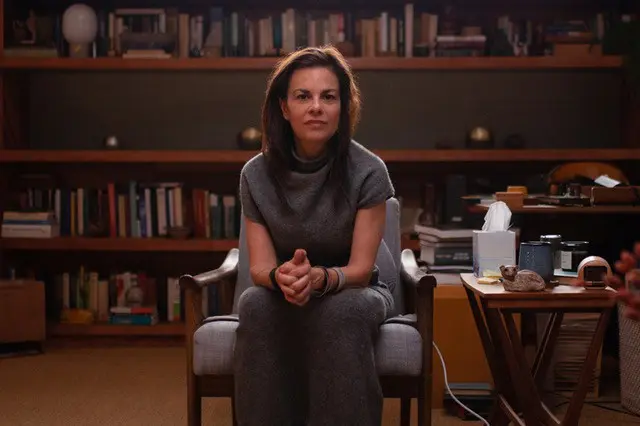
Kriegman, the son of two therapists, first approached the series as an experiment: could therapy be captured authentically onscreen? To maintain a sense of normalcy, all cameras were hidden behind one-way mirrors, the crew was kept out of sight, and the set was modeled after Guralnik’s own office, down to the smallest details, like the books on the shelves and the precise distance between her chair and the therapy couch.
But arguably the most compelling testament to the show’s authenticity is Guralnik herself, who was originally intended to be the lead therapist’s supervisor, and only agreed to accept the starring role on the condition that the series wouldn’t be “selling drama,” but rather capturing the real work of therapy. For many viewers, Guralnik knew, this would be their first introduction to the world of mental health.
“I was very ambivalent,” she told the Israeli daily newspaper Haaretz. “I wondered whether it was even possible to do therapy in front of cameras that would feel like therapy and not something else.” Guralnik had another stipulation: that the show steer clear of her personal life, so as not to “misrepresent the work” and “contaminate the honest representation of the process of what therapy is really like.”
For Kriegman, Guralnik’s strong convictions were another sign that they could create something genuine. “In addition to Orna’s brilliance, her expertise, her charisma, and her insight—all the things that make her a really remarkable therapist,” he added, “she also isn’t that interested in being on TV.”
Of course, this reticence hasn’t stopped viewers from fixating on what little they can see of Guralnik’s personal life, which has turned her into something of a fashion icon. Fans across TikTok and Instagram share screenshots of her braids, visible tattoos, leather bracelets, and chunky tops. “We All Want to Dress Like Orna,” reads the title of a recent New York Magazine article. There are Pinterest boards dedicated to “Orna Guralnik Style.” And there’s an entire subreddit where viewers gush over their favorite Orna outfits.
“The asymmetrical/one-sleeve sweater tank is a SLAY,” writes one commenter.
“I have two because of her,” another replies. “So chic.”
“Love her style,” writes a third. “Very bohemian yet put together.”
It’s worth noting that the show’s production value only reinforces this therapy-as-fashion—and the mystique surrounding Guralnik. Her office is the quintessential safe container, with its book-lined shelves, warm lighting, and earthy green and tan accents—sharply contrasting with the concrete and chaos of New York life depicted outside. The cinematography is crisp and modern, with intimate over-the-shoulder shots, close-ups, and background fading that focuses the viewer’s attention. Toward the end of the first episode, we follow Guralnik as she leaves work and boards the subway. The camera sways as she stares ahead silently—pondering, metabolizing, or maybe just catching her breath. It’s this masterful use of silence in and outside of Guralnik’s office—what’s felt but never spoken—that makes for some of the show’s most powerful moments.
Between her therapeutic skill, professional integrity, and keen fashion sense, Guralnik seems to have won everyone’s heart—and somehow while remaining a mystery. Who is Orna Guralnik? Where did she come from? And what does she do when she’s not saving partners from themselves? These were the questions running through my head as my wife and I eagerly pressed play on another episode. Years later, with the series now four seasons deep and with a fifth on the way, I still didn’t have the answers. So when I recently got the chance to sit down with Guralnik and—maybe, hopefully—learn the truth, I rummaged through my closet, picked out my chunkiest, most fashionable sweater, and prepared to uncover a mystery six years in the making.
Always Meet Your Heroes
On a Wednesday afternoon in September, sitting behind a computer screen in my living room, I finally come face to face with Guralnik herself—and admittedly, I’m a little nervous. How do you begin hellos with someone you’ve watched from afar for years—someone who’s not only held your attention, but made you smile, laugh, and think deeper about your own romantic relationship—yet this someone knows virtually nothing about you?
I decide to start with a smile and a tentative wave. A bespectacled Guralnik, standing in a black hoodie in front of a messy stack of books, file folders, and black-and-white photos, smiles back. Gone is the soft lighting, the modern art, and the big, decorative rock that sits in her waiting room on the show. Somehow, their absence puts me at ease.
What I know about Guralnik amounts to what I’ve seen on Couples Therapy: she’s a psychoanalyst, a New Yorker, and she takes the subway home. Otherwise, I’m in the dark—which isn’t necessarily a bad thing. There’s nothing worse than seeing the look of shock and fear on a stranger’s face when you excitedly mention the name of their childhood best friend or how much you loved their rendition of “Luck be a Lady” in their middle school production of Guys and Dolls. So instead, I begin with a simple question: what inspired her to become a therapist?
Guralnik tells me it all started in her late teens, when she was living in Israel and seeing “an incredible woman” for therapy. The experience inspired her to begin reading R.D. Laing, Freud, and Whitaker, who she says “introduced me to a new language.” It felt “like a door had opened,” she continues, “like I could now understand the world better. What had once seemed chaotic and inexplicable suddenly fell into place.” But the path to a therapy career was hardly a straight line.
“I danced, painted, and studied film,” she explains. But unsatisfied after getting her film degree, she moved to the U.S. and instead began studying to become a therapist. Having a foot in two worlds, she says, was well-suited to the complex dynamics of couples therapy.
“Having switched languages, identification, cultures, climates, and histories has made me pretty tuned in to the way these dimensions play out in people’s lives,” she says. “It happens to be very helpful with couples, because to some degree they’re negotiating a different culture between them.”
But Guralnik didn’t choose to study the latest modality. She chose to study the oldest one: psychoanalysis. Guralnik calls herself a systemically oriented couples therapist, meaning she doesn’t view partners as individuals, but as a system. Admittedly, just hearing the word psychoanalysis brings to my mind a certain bearded, cigar-smoking Austrian neurologist and his quirky ideas about mothers, sons, and the alleged sexual tension between them. And as Guralnik begins to talk about the brilliance of psychoanalysis, a part of me wonders: Isn’t this a little antiquated? A little detached from today’s realities? But I’m not too proud to be wrong. So I ask her: is psychoanalysis really a good fit for today’s clients and problems?
Guralnik lights up. “Oh, in profound ways,” she replies. “First, in the ways it’s always been important, which is paying attention to the huge part of our mind that’s unconscious. That’s the key tenet of psychoanalysis, and with that comes emphasizing the importance of what happens early in life as something that shapes you later in life and how you approach the world. Those truths are a major contribution of psychoanalysis—the attention to what is not yet made explicit by linear, organized thinking.”
Watching Guralnik onscreen, you see how this perspective is woven throughout virtually every aspect of her work. I think back to a scene from season three of Couples Therapy, where she’s sitting down with partners India and Dale. India tells Guralnik about the struggle of juggling a full-time job with caring for their infant daughter, and says it’s beginning to breed resentment at home.
“I prepare her breakfast, lunch, and dinner,” India says sharply. “I have fed her from my body for months.”
“I’m not debating whether or not you do a good job,” Dale says plainly.
“Yes, you are saying that,” India retorts.
Guralnik interjects. “So you’re saying in the way Dale narrates things, he doesn’t acknowledge you. Let’s say Dale wants to congratulate you. How would it sound?”
“’Wow, we really survived this pandemic together,’” India narrates. “‘I can’t believe it, but we did, and I’m so grateful.’”
Dale turns to India, and you can hear the pain in his voice. “But I say these things to you, babe.”
“Maybe not enough?” Guralnik offers.
“Okay, maybe not enough,” Dale admits.
India turns to Guralnik. “Every time I hear him say, ‘You’re gone six days a week,’ it just grinds and grinds and grinds,” she says, twisting a fist in her palm. “It puts this unnecessary pressure on me to make a decision: you gonna work, or you gonna stay home?”
Guralnik lowers her gaze and zeroes in on both partners, as she often does right before dropping a truth bomb.
“I do think in this case what’s happening is that what you’re hearing in Dale’s voice is really your own inner conflict,” she says. “I don’t really hear it coming from Dale.”
It’s a revelation. India nods. She begins to speak, but catches herself and pauses. “I’m very hard on myself,” she finally says.
“You are,” Guralnik replies.
“I’m very hard on myself.”
Nobody says anything. Dale reaches out and gently touches the back of India’s neck.
The Art of Being Orna
Any clinician will tell you that therapy is as much an art as a science. Knowing when and how to say something is as crucial as knowing what to say. Guralnik is a master of all three. But what’s her secret? Is there something she looks for before deciding to wade in? Particular words? Tone? Body language?
“It’s all of that—and the relationship in-between,” she tells me. “I’m tuned into facial expressions, tone, body language, and music. When a couple is sitting together, there are all sorts of nonverbal elements happening in the room. What’s particularly interesting,” she continues, “is the relationship between those. It’s the old psychoanalytic concept of mystification—when the words and behavior don’t match. One of my goals with couples is for there to be harmony between what they’re saying, doing, and feeling. That’s when people function at their best.”
So does this come naturally to her, or does it take conscious effort?
“It does become second nature,” she says. “But I think compared to other therapists, psychoanalysts are a little weird in the way we listen. Sometimes when people are talking to me, I’m not always hearing exactly what they’re saying. I’m somehow tuned into another register. It’s hard to describe, but I think a lot of analysts listen this way. Certain things will go over my head, and I won’t even clock it because something else feels more pressing. Psychoanalyst Theodor Reik had a term for this: the third ear.”
But what about when the volume gets cranked up? After all, this is couples therapy, where clients’ patience is often short, emotions often run high, and therapists must balance compassion with accountability for both partners. I think back to a particular scene from season one of Couples Therapy, where Guralnik is sitting down with Annie and Mau—the latter of whom the online masses have overwhelmingly decided is the villain here.
“I think there’s a much more emotional underlying structure to this,” Guralnik tells them.
“Okay,” Mau says dismissively. “How can we quickly determine whether that’s true or not?”
Guralnik stands firm. “You can ask yourself whether you want to take some of what I’m saying to see if it’s useful, or if you want to spar with me,” she replies. “If you don’t want to spar with me, we don’t have to discuss the accuracy, we just have to see if it’s useful.”
“I don’t know how to do that,” Mau replies sheepishly.
It’s a standout moment from the series, an incredible display of therapeutic judo and self-control on Guralnik’s part. I ask her: how do you approach confrontation, not only when it’s directed at partners, but at you?
“First of all, I’m half Israeli,” she replies. “Not an easy thing to acknowledge at this moment in time. But for good and for bad, it means that compared to other cultures, I have a pretty high tolerance for conflict. I don’t get terribly rattled by it, and at this point I can tell when it’s productive and when it’s destructive. Conflict is productive when partners are saying hard things to each other and can have a real exchange—and I’m fine with people addressing me that way too. But dishing out abuse? I have zero tolerance for that. I’m not interested in sitting in a room with people who are just dumping bad feelings on each other. So there’s conflict, and then there’s conflict.”
Guralnik and I proceed to discuss some equally delicate aspects of clinical practice: leaning into uncomfortable conversations with clients about race, gender, and sexuality (“Don’t be afraid of putting your foot in it. Offend, make a mistake, say something wrong. It’s fine. It’s part of the process”), whether therapists should feel free to talk politics with their clients when relevant (“Absolutely. We’re living in a really difficult, destructive time in history, and we all have responsibilities as citizens”), and all things self-disclosure (“If your office is all-beige and there’s no sign of life in it, that’s incredibly self-disclosing! In my office there’s art, some of it quite provocative. That reveals a lot too”).
As far as I can tell, Guralnik is fearless. She may not run into burning buildings or handle venomous snakes, but she sure as hell does the therapeutic equivalent.
Subtle Magic
Midway through my conversation with Guralnik, something dawns on me: I’m not feeling nearly as anxious as I was when we began. Quite the opposite, in fact. My shoulders are relaxed, my heartbeat has slowed down, and my breathing is more measured. Maybe it’s because Guralnik and I have been using a similar vocabulary that attunes us—words like resistance and safe container—or maybe it’s because we discover we have a mutual friend in couples therapist Bill Doherty.
But I know the likelier reason is Guralnik herself, that it’s the steady cadence of her voice, the way she holds eye contact and nods to communicate interest, and her willingness to share conversational space that brings my guard down. I don’t feel pressured to speak quickly, or for my questions to be perfectly polished, as I’ve felt in other interviews. I don’t feel like I’m being regarded as an outsider because I’m a journalist, not a therapist. I feel invited to speak. I imagine the couples in Guralnik’s office probably felt the same thing: permission to feel vulnerable, without the fear of judgment.
As the interview winds down, I do uncover more of the mystery I initially set out to explore. I do learn details about Guralnik’s personal life that she’s previously kept private. I learn that she does Vinyasa yoga, that she loves going to art exhibits with friends and writing poetry. But frankly, these are details I don’t really need. I’ve learned—experienced, rather—that the reason people find Guralnik so magnetic isn’t because of the stylish clothes she wears, or her trendy office décor, or some fancy camera work. It’s because of the way she makes you feel. That’s the Orna Effect.
As Guralnik and I say our goodbyes, I remember a quote from Maya Angelou: Eventually, people will forget what you said. They’ll forget what you did. But they’ll never forget how you made them feel.
It’s usually an exaggeration to say a single conversation has changed you. But I have changed a little. Thanks to Couples Therapy, my view of reality TV has shifted: I don’t hate it nearly as much as I used to. I no longer smash the thumbs down button vindictively whenever an ad for The Bachelor crosses my screen. Instead, I pause. I scoot a little closer to my wife on the couch and pull up a blanket. I decide to give it a chance. Does this mean I’m becoming a more flexible, open-minded partner too? Maybe. If so, I have Orna Guralnik to thank for that.

Chris Lyford
Chris Lyford is the Senior Editor at Psychotherapy Networker. Previously, he was assistant director and editor of the The Atlantic Post, where he wrote and edited news pieces on the Middle East and Africa. He also formerly worked at The Washington Post, where he wrote local feature pieces for the Metro, Sports, and Style sections. Contact: clyford@psychnetworker.org.