

One night, the emergency room summoned me at 3 a.m. When I arrived, two nurses and two police officers were waiting for me. I recognized one nurse. Everyone knew she was one of the meanest people at the hospital. The other nurse was a man, tall and strong. The police officers, in full uniform with batons and holstered guns, were stockier but still huge. They explained that a mother had brought her adult daughter to the ER. They gestured to the mom, sitting patiently in the waiting room. Her daughter, Vanessa, had just been released from rehab, detoxing from heroin and who knows what else.
The scenario before my arrival had gone something like this: The mean nurse tried to force Vanessa to take an injection of Ativan, an antianxiety drug that can take the edge off withdrawal symptoms. Vanessa freaked out. The mean nurse could not subdue her, so she called the male nurse for help; Vanessa fought them both off. They called the police. Vanessa took on all four of them—and won!
They pointed to a door. Vanessa had barricaded herself in a supply closet. That closet contained not only gowns and blankets but also glass supplies and a disposal bin for used needles and other hazardous waste. Not a safe space.
No sound came from the closet.
They turned back to me. “So we thought this would be a good time for Behavioral Health to help.” A better guess is that they probably just wanted to catch their breath. I wouldn’t even be surprised if they planned to use me as bait to distract the patient while they went in for a final attack. “So go therapize her.”
I looked at the door, thinking of all the ways I could make weapons out of what was in that closet. But my client was on the other side, so I opened the door and walked in.
What I found surprised me. Vanessa was sitting on the floor in the corner, knees pulled toward her chest, under a beige open-weave hospital blanket. She was rocking back and forth. She didn’t react when I came in. When you pull an open-weave blanket close to your face, you can see pretty well through the holes. So I knew she could see me, even though I couldn’t see her.
My mind was racing. My heart was racing. I didn’t want to leave this woman to the brute force waiting outside the door. However, I worried that I wouldn’t be any more help. It was easy to see that conventional therapy approaches would not work—she was not ready to hear any reframing of her situation or suggestions about steps to take. What did the person in front of me need right now? She needed to feel better and less threatened. So I dropped to the ground on the other side of the supply closet and curled up in the same position as Vanessa, but without a blanket over my head.
I didn’t introduce myself. I didn’t ask her any questions about her past, how she started using drugs, or her current symptoms. I didn’t ask her to remove the blanket.
Instead, I took a deep breath and in a low, soft voice started a mindfulness meditation. “Inhale and feel the breath flow in, expanding your chest and belly. Exhale and feel the chest and belly relax and any stress flowing away from you.” I exhaled audibly as I said this, inhaled, and continued: “You may notice that the air feels cool as it enters your nostrils, flows into your lungs, and warms slightly as you exhale. As you breathe, you may find that the exhale lasts slightly longer than the inhale. Inhale . . . 1 . . . 2 . . . 3 . . . 4 . . . Exhale 1 . . . 2 . . . 3 . . . 4 . . . 5 . . . 6. As you exhale, feel your stress leave your body and flow into the ground.”
Ten minutes passed like this. Then twenty minutes. Vanessa didn’t move or speak. I kept chanting the meditation. Thirty minutes passed, then forty. We were still breathing together.
Suddenly, Vanessa yanked the blanket off her head. “Who are you?”
“I’m Dr. Hamby, and I’m from Behavioral Health. I heard you were having a tough time tonight. I understand you just got out of rehab?”
She nodded.
“It looks like you are still experiencing withdrawal symptoms. That can happen. Detox can be unpredictable. But if you want, they can give you something to take the edge off those symptoms. Then you can go home with your mother.”
“My mother is still here?”
Truthfully, I didn’t know if her mother was still there or not—after all, I’d been in the supply closet for almost an hour. But I figured that the kind of mom who waits patiently in the ER at 3 a.m. is the kind of mom who would still be there at 4 a.m. So, more confidently than I felt, I said, “Yes, yes, your mother is here. If you let them give you something, you can go home with her and get some rest.”
“I can go home?”
“Yes.”
We left the supply closet together. Her mom was still there! So were the nurses and police. Their four jaws hit the ground in what I will admit was a most gratifying fashion. Vanessa calmly accepted the Ativan and went home with her mother. I saw her the next day when she came to follow up with her regular therapist. Vanessa warmly thanked me and said she felt a lot better.
This encounter left me with questions about our standard approaches to trauma—and it points to something the field has been slow to recognize.
The Third Revolution
The first two revolutions in trauma science showed the world the true impact of exposure to trauma. The first revolution established that violence and abuse of all kinds are major public health problems with lasting consequences; the second showed that it’s the cumulative lifetime burden of trauma—not any single event—that most shapes our health. The findings from this research changed the world. From trauma-specific therapies to new laws and specialized agencies and courts, society was transformed by an awareness of the widespread prevalence of trauma and its many harms.
However, we still didn’t know much about healing. In fact, if you read a lot of this literature, you might think healing is rare, if not impossible. One big problem of the first revolution in trauma science has been the split into specialized areas of research (silos) that overlooked the cumulative impact of trauma over a lifetime. The second revolution addressed this problem by uncovering the connection between trauma dosage—our lifetime experience of different types of trauma—and adverse health consequences.
The first revolution also had another problem: its portrayal of trauma survivors. Even now, survivors are often portrayed in remarkably negative terms. Media images can play up injuries like bruises and cuts, even though most interpersonal violence does not lead to that kind of visible injury. Victims are often portrayed as helpless and in need of saving. Or worse, doomed to a lifetime of depression and PTSD.
These portrayals help some people. They help researchers and advocates convince policymakers to invest in grants and programs for trauma survivors. Dramatic images help journalists get eyeballs on their articles. As they say, “If it bleeds, it leads.”
I don’t think these portrayals are helpful to survivors, though. For years, people with disabilities have pushed back on being used as “poster children” for fundraising. What good is the money if it creates new problems of stigma and pity? It’s the same for trauma survivors. All that public awareness has come with a cost. Further, stereotypes about what trauma looks like can make it hard for us to recognize our own traumatic experiences, which come in many forms.
Research has shown that most survivors of the 9/11 attacks in New York never developed PTSD. Their story is not an unusual one: The most common response after trauma is resilience. Resilience scientists have shown this again and again. We generally find that more than two out of three people are doing well, despite exposure to trauma. Many are not just below the thresholds for a formal diagnosis of PTSD or depression—they are experiencing true well-being. For instance, many children who are trauma survivors are still meeting developmental goals as they should.
More than twenty years ago, resilience scientist Ann Masten coined the phrase ordinary magic to describe how many people manage to thrive after trauma. Yet for years we didn’t have a good understanding of how people accomplished this, especially considering all the harms that are caused by trauma. This is not some kind of automatic or lucky occurrence. It’s not just a matter of waiting around until we feel better. We were missing the ways that people harness assets and resources, often without professional help. People who thrived after trauma were already building strengths, although they weren’t aware of the science behind it. The resilience-portfolio approach (leveraging our toolkit of assets and resources for dealing with trauma) can help you to more consciously build these strengths, now that you know they make a real difference.
This is where the third revolution comes in.
Dosage for Resilience
The third revolution in trauma science, going on now, brings the concept of dosage to the strengths side of the resilience equation. We now know that if you can harness enough assets and resources, you can counter even high dosages of trauma. It is still possible to put together a good life even after a lot of very bad things.
Like early research on trauma, early research on resilience was also often siloed and hyper-specialized. Researchers frequently looked at only one kind of trauma (like a flood or an assault) rather than people’s full lifetime dosage, making it harder for them to understand why some people were doing better than others. Early resilience researchers also often studied one strength, such as social support or emotion regulation, at a time. Although there are lots of assets and resources available to us, what most people want to know is which ones help the most. If you have limited time, should you focus on beefing up your social support, your emotion regulation, or something else? Therapists and teachers also have limited time and resources to help someone, so they need to know what is most useful as well. This is the key to the resilience equation. We need to know which strengths will help us recover and how to get enough of them.
This is a radically different way to think about healing. Most therapy and psychiatric medications focus on taking away symptoms. If you have PTSD, then remove hypervigilance and avoidance. But the resilience equation points to bringing more good things into your life in order to heal. This connects to work in the relatively new field of positive psychology, which is the study of the good things about being human. We can use some of the tools from positive psychology to build our dosage of good stuff and learn to thrive after trauma.
A Different Approach to Healing
A lot of conventional trauma therapy does not look very different from therapy for depression or other problems. The basic script is the same—sit in an office and talk about your past. Even many domestic-violence shelters, which often have numerous rules and curfews, are not too different, in some ways, from inpatient psychiatric hospitals.
Although these kinds of services have helped a lot of people, they have their limitations. There’s no such thing as perfect therapy, any more than there is such a thing as a perfect scientific study. There is always room for improvement. For one, much classic therapy spends most of the time looking backward and focusing on symptoms. I’ve heard some people in long-term therapy say that they find themselves making mental notes about the hassles of their week to discuss in their session. There are limits to how much any of that helps people put together the pieces of a good life. Some scholars even think that our focus on the negative consequences of trauma is basically telling people to expect depression and anxiety.
There are, fundamentally, only three ways to help trauma survivors. Two of these—the mobilization and better-coping pathways—are strongly linked to the old ideas about helping people overcome trauma. The first, mobilization, focuses on taking direct action to address the presenting problem; the second, better coping, helps people swap harmful or ineffective strategies for healthier ones. The third, the positive pathway, emphasizes interventions that build strengths, which, as we’re learning, directly support well-being. For most of us, focusing on the positive pathway is the best way to enhance our resilience portfolios. And you can follow the positive pathway at any time—you don’t have to wait for a crisis.
With Vanessa, I met her where she was and didn’t try to make her play her part in the therapy script. Although I am not suggesting that a single meditation transformed her life, this crisis intervention is a good example of the third approach to helping people: the positive pathway. Sometimes the best way to help people is not by processing what happened to them. Sometimes what helps doesn’t even involve mentioning prior trauma. In this case I helped her feel well enough to consider a better coping strategy in the form of using Ativan as a temporary alternative to heroin or other drugs.
However, the positive path is not just about getting ourselves ready to cope—it’s about making our whole lives better. Sometimes our focus on insight and past problems can keep us looking backward. We can’t lose sight of our real goals. Everyone wants to achieve well-being despite what has happened to them.
The goal is not to pretend that the trauma didn’t happen but to recognize that you are going to get only so far by revisiting the past. Never mind why you need help. Where do you want to end up? For decades, psychologists like Abraham Maslow, Carl Rogers, Joseph White, Barbara Frederickson, and Martin Seligman encouraged us to think beyond mental illness and symptoms and focus on well-being and meaning. In the last twenty-five years, the positive psychology movement has been gaining steam and is now one of the dominant fields in psychology.
Although positive psychology does not focus on trauma, insights in this field have much to offer trauma survivors. With the positive pathway, we can shift our focus from what happened to developing the psychological, social, and environmental strengths we need to thrive now. These are essential elements in your resilience portfolio.
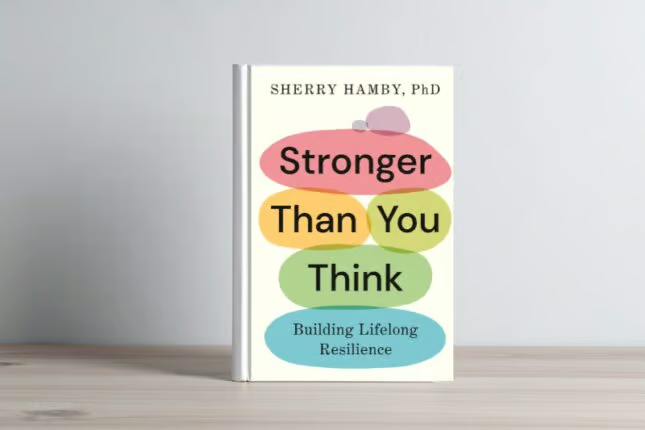
From Stronger Than You Think by Sherry Hamby, published by Penguin Life, an imprint of Penguin Publishing Group, a division of Penguin Random House, LLC. Copyright © 2026 by Sherry Hamby.

Sherry Hamby
Sherry Hamby, PhD is an award-winning distinguished research professor of psychology at the University of the South. She is also the director of the Life Paths Research Center and founder and cochair of ResilienceCon, a conference on strengths-based approaches to overcoming trauma. Dr. Hamby has authored or coauthored more than two hundred scholarly articles and five books, most recently “Stronger Than You Think,” and her work has appeared in the New York Times, USA Today, and HuffPost, and on CBS News. She lives in Tennessee with her husband, two children, and two rescue dogs, Flopsy and Slim.