
Enjoy the audio preview version of this article—perfect for listening on the go.
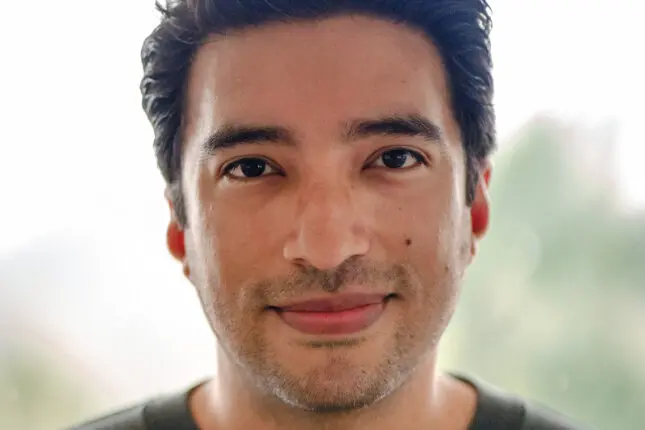
The idea that self-reflection enhances relationships is as old as the hills. It’s been explored by writers, poets, and philosophers like Sappho, Plato, Rumi, Jane Austen, Kierkegaard, and Erich Fromm. And these days, it has a new advocate: Diego Perez, a.k.a. Yung Pueblo.
Pueblo’s bona fides didn’t come from doing marriage and family therapy or couples counseling. He’s not a psychiatrist or a clinical researcher, though on his months-long silent meditation retreats, he’s spent more time studying the inner workings of the human mind than your average neuroscientist (“I’ve probably meditated around 13,000 hours now,” he says in one interview). Basically, he’s a regular guy, a millennial Ecuadorian American who, as a young adult, struggled with addiction, fought with his then-girlfriend (now wife), and one day, went on a Vipassana meditation retreat that—quite literally—changed his mind. Now, as an influencer, author, and meditation teacher, he’s breathing new life into age-old insights, reacquainting therapists and non-therapists alike with the centuries-old notion that working on the self makes us better partners.
It’s not always clear why certain influencers are popular, but Pueblo’s backstory as an immigrant who grew up poor before turning to meditation is a kind of modern rags-to-spiritual-riches tale with broad appeal. I’m pretty sure there’s a Hollywood biopic based on his life’s story somewhere in our future. He’s written four bestselling books—Inward, Clarity and Connection, Lighter, and How to Love Better (the kinds of titles you’d expect to find in the Psychology section of bookstores)—and was recently named a top creator in Time Magazine’s Time100 creators list.
Though Pueblo himself doesn’t necessarily chase the limelight, the limelight is most definitely chasing him. He’s been the featured guest on popular television interviews, summits, and wellness podcasts like The Mel Robbins Podcast. And in the mental health world, he’s rapidly achieving David Whyte status as the poet laureate of relationships. Psychologist Rick Hanson, who met him through his son Forrest, says, “Diego is appealing due to his great sincerity, his abilities as a talented poet to speak eloquently about his own journey in therapy and mindfulness, and his capacities to cross divisions of age, ethnicity, and other ‘fences.’”
Pueblo’s creativity isn’t limited to books and Instagram content. Along with entrepreneur and former Google employee Ruchika Sikri, he’s cofounded a dating app called Ready that distinguishes itself from other dating apps by claiming to be “a practice in presence, a space to grow, a mirror for who we’re becoming,” reflecting Pueblo’s stance on romantic love’s deeper purpose as a crucible for consciousness. No superficial, mindless swiping for Ready’s users, who are referred to as “members,” a tasteful nod to the theme of connection and belonging that runs through Pueblo’s entire oeuvre. The app also offers self-reflection prompts and suggests emotionally compatible matches. Even if the Buddha himself were able to time travel into the 21st century and create a dating app or build a social media platform, he’d be hard-pressed to outdo Ready or Pueblo’s over 3.1 million followers, which include meditation gurus like Sharon Salzberg.
But perhaps most importantly, especially for therapists, Pueblo crystallizes the kinds of relational concepts we’re always striving to help our clients embody. Even his pseudonym—which means “people” or “community”—has relational undertones. His insights about self-awareness and growth, however familiar, are communicated in ways that are earnest and penetrating. If you were to take a scroll through his Instagram feed, you’d quickly notice that whichever quote your eyes alighted on seemed to have been created just for you.
May you attract someone who thinks you are the best thing that has ever happened on Earth, one post reads. Everything I lose creates space for everything I need, another comforts. The moment your gut says no, it’s a no. You can unpack the details later, a third encourages. Three things will always come out, another wisely warns. The sun, the truth, and karma. Pueblo’s style—sans serif fonts in lower-case letters on plain backgrounds—is simple, unpretentious, and piercingly poignant.
In a recent interview with couples therapist Alexandra Solomon on her podcast Reimagining Love, Pueblo says he’s been tracking trends in relationships and healing through his millions of Instagram followers. “In 2016,” he reports, “everyone was talking about self-love and trying to figure out Is it valuable? How can I use it? Then the conversation changed. From 2017 to 2019, everyone started talking about letting go, wondering, How do you actually enact this letting go in your life so you don’t have to feel so much tension in your mind? And then from 2019 to 2021, everyone started talking about boundaries. Where do I put them up? How do I hold them? Lately, the focus has been on how the work we’ve done impacts our relationships.”
When it comes to a new movement toward collective healing he senses in our culture, he says, “I think we’re all just tired of being miserable. And I think it’s beautiful that so many people are seeking different kinds of therapy and asking, How can I deal with the heavy emotions that have been imprinted on my mind?” Solomon—who’s keynoting a Psychotherapy Networker Symposium event this March entitled “The Future of Forever: Marriage in an Age of Individualism” alongside Pueblo and therapist-influencer Nedra Glover Tawwab—says his Instagram account was one of the first she followed in 2016 when inspirational content on social media was still in its infancy.
“He’s deeply humble despite being wildly successful,” Solomon says of Pueblo. “And there’s lots of overlap in our work. He understands the link between self-awareness and connecting well with others. I think therapists in particular, who are trained in holding complexity, can appreciate how his concise phrases capture facets of the human experience like puzzle pieces fitting into place.” Tawwab describes Pueblo as having a calming energy, both in person and online. “Not only does he make room for our imperfections, but he also guides us toward becoming mentally equipped humans.”
In his interview with Solomon, Pueblo shares openly about his own romantic relationship, and how it’s transformed over time. “My most important relationship is with my wife, Sara. Love has so many ups and downs, and lately we’re finding that even in the down moments, when we know there’s tension between us, we’re still held together by a layer of peace and not seeing each other as an enemy.” When he and his wife argue, he says, he reminds himself, Okay, I’m talking to my favorite person here. Even though we may disagree, I’m still in a relatively safe environment. “When I was writing my first book and my wife was working as a scientist,” he says, “we sometimes spent days apart. I started learning that even if I’d had a challenging day, I needed to own that fact and still treat her with gentleness because I didn’t really know how her day had gone.”
Over time, meditation showed Pueblo that the whole universe is one of motion and change, and that he was part of that change. “As Sara and I have gotten older,” Pueblo says, “embracing growth has brought us the most harmony in our relationship. It means we see where we struggle and then put energy into that area. For instance, I’ve recognized that I’m not a naturally good listener and that I needed to work on that. Through repetition and intentionally re-pointing my attention back to Sara’s words when she talks, I’ve learned to be a better listener.”
“They truly walk the talk,” Solomon says of Pueblo and his wife. “Their love story bridges very different backgrounds and experiences.” In a culture where tradwife proponents and misogynistic media personalities accrue sizable followings, Pueblo embodies a vital counternarrative to the myth that we’ve got two options in romantic relationships: dominate or submit. He highlights a third option: growing together in a mutually supportive relationship.
Sometimes it takes a voice from outside the field to help us inspire relational change in our clients and ourselves. In an age when so much of what goes viral is brain rot and rage bait—low-quality or incendiary social media content—Pueblo’s vision of conscious love seems to reflect a broader collective hunger, one that offers hope for a more relational world beyond the confines of self-help books, monasteries and therapy rooms.

Alicia Muñoz
Alicia Muñoz, LPC, is a certified couples therapist, and author of several books, including “Stop Overthinking Your Relationship” and “A Year of Us.” Over the past 18 years, she’s provided individual, group, and couples therapy in clinical settings, including Bellevue Hospital in New York, NY. Muñoz currently works as a senior writer at Psychotherapy Networker. Her latest book is “Happy Family: Transform Your Time Together in 15 Minutes a Day.“