

Enjoy the audio preview version of this article—perfect for listening on the go.
Over the years, I’ve heard lots of people liken intimacy to a soft place to land, usually in a relationship. This way of thinking about it feels true, but also makes intimacy seem optional. So instead, I’ve started thinking of it more like vitamin D—although our skin makes it naturally when exposed to UVB rays (just 10 to 20 minutes in the mid-day sun will do it), many of us are lacking this essential nutrient. Without vitamin D, our muscles weaken, we get sick more often, our mood plummets, and we have trouble sleeping and concentrating. Interestingly, when you’re intimacy deficient, similar things tend to happen.
If only a simple blood test could measure not only the vitamins and minerals in our bodies, but whether we’re experiencing enough intimacy in our lives. Medical professionals might start paying attention to the quality of our close relationships. And we might all start asking some important questions. Are we doing enough to help clients identify and experience actual intimacy, the kind that involves a frightening amount of risk but has the potential to pay us back in spades? Are we overlooking the value of platonic love by centering so much of our clinical work on exploring romantic love? And speaking of romantic love, how can therapists help clients navigate dating-app culture in a way that’s genuine, realistic, and sane?
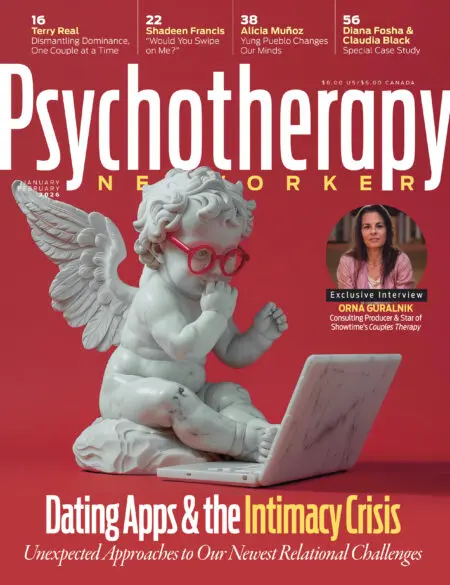
No one knows better than therapists that intimacy is a fundamental human need—Maslow’s hierarchy was amended long ago to put love and belonging on the same level as physical safety. And there’s no need to prove that increasing numbers of people are struggling to get that need met—that seems obvious given the booming coaching industry that’s cropped up to help people get more swipes on dating apps and our collective flocking to AI chatbots for warm, comfortable conversation even when we’re in a steady partnership. The point of exploring the age-old topic of intimacy—or “into-me-see,” as Esther Perel popularized it—is to help us think about it a little differently amid our current cultural milieu. After all, here we are, in 2026, wrestling with what Justin Garcia, executive director of the Kinsey Institute and scientific advisor to Match, describes as a full-blown “intimacy crisis.”
In this issue, we showcase Garcia’s advice, excerpted from his new book The Intimate Animal, on the importance of physical chemistry and how to account for that in the world of dating apps. It makes you wonder: Are we prepared to help clients move from online connections to in-person relationships? Can we help them stay afloat in a culture in which billions of daily swipes yield an average match rate of roughly 2 percent? Are we willing to look at the dating profiles they’ve painstakingly created and ask the right questions, even when they look at us earnestly and implore, “Would you swipe on me?” A standout story from sex and couples therapist Shadeen Francis offers a fresh perspective on these and other questions, and I promise it will shift the way you work with the next client who walks into your office struggling with online dating.
Other standout pieces include a fiery new article from Relational Life Therapy developer Terry Real, in which he makes the compelling argument that the intimacy we foster in therapy is the antidote to the autocracy we’re fighting in the world. We also feature a decidedly intimate interview with Orna Guralnik, clinical producer and star of Showtime’s Couples Therapy. And we profile another interesting figure making waves among clinicians: Yung Pueblo, whose bestselling books have earned him the moniker of the poet laureate of relationships.
Given that this is the first issue of 2026, we’ve done our best to set the tone for the new year by balancing the latest bold ideas and cultural trends with articles focused on the nitty-gritty details of clinical work. In this vein, five well-known therapists offer advice about what to do when you find yourself attracted to your client. (I know—yikes!—but it’s a far more common issue than you think!). AEDP developer Diana Fosha and addiction specialist Claudia Black walk you through the case of a client with a history of parental neglect. (This is like supervision on steroids!). Couples therapist Jayne Gumpel invites you to consider turning your session notes into poems—not with the goal of creating a literary jewel for public viewing (please don’t do that), but to use as a clinical tool that deepens your relationship with your clients, and your clients’ relationship with therapy.
And while we’re sticking a toe outside the traditional clinical box, consider the meaningful impact you could make by expanding your individual psychotherapy practice to treat friends: close friends struggling to stay connected or heal after an argument or betrayal. Given our skillset, why wouldn’t we work with them just as deeply as we would with a couple, or even an entire family? After reading Barbie Atkinson’s story about pivoting her practice to friendship therapy, you might suddenly find the doors of your clinical imagination blown wide open.
That’s a lot for the start of a new year, when we’re all just trying to get our ducks in a row, or at least in some kind of loose formation. If you’re like me and tend to eschew January goal-setting rituals, I hope you’ll still aim to make reading (or listening) to Psychotherapy Networker stories a regular practice in 2026. In highlighting practical yet soul-filled stories that feel like intimate conversations with trusted colleagues, we want the experience to feel as natural as stepping out into the sunlight for a bit of vitamin D.

Livia Kent
Livia Kent, MFA, is the editor in chief of Psychotherapy Networker. She worked for 10 years with Rich Simon as managing editor of Psychotherapy Networker, and has collaborated with some of the most influential names in the mental health field on stories that have become widely read articles and bestselling books. She taught writing at American University as well as for various programs around the country. As a bibliotherapist, she’s facilitated therapy groups in Washington, DC-area schools and in the DC prison system. In 2020, she was named one of Folio Magazine’s Top Women in Media “Change-Makers.” She’s the recipient of Roux Magazine‘s Editor’s Choice Award, The Ledge Magazine‘s National Fiction Award, and American University’s Myra Sklarew Award for Original Novel.