
Enjoy the audio preview version of this article—perfect for listening on the go.
As a psychotherapist who works with patients navigating intergenerational trauma, I’m attuned to family narratives—what’s spoken, withheld, or repressed, and how it echoes forward. I can’t remember how I first came across the testimony of Moshe, a relative from my paternal grandmother’s generation. My grandmother never spoke of her mother or aunt, not to me, not to anyone, as far as I know.
Over the years, I’ve spent hours searching our family history online, uncovering stories of hardship and survival, of families scattered across the diaspora. None of it prepared me for Moshe’s voice.
Recorded by the Shoah Foundation in the 1990s—an archive created to preserve testimonies of Holocaust survivors—this video testimony opens on Moshe’s face: a warm smile and expressive eyes holding memory, clarity, and trauma at once.
As he speaks, I realize I’m hearing my extended family’s truth, realities never spoken aloud from my immediate family but somehow known in my bones—a history passed down through implicit messages, epigenetic trauma, loss, survival, and resilience.
Moshe describes growing up in two distinct worlds in Berlin. There was the outside world: public school, the streets, life among non-Jews, where Jewishness had to be managed, softened, or even hidden behind a German name that wasn’t his own. And then there was the inside world: home, Jewish community, language, ritual, song, his proper Hebrew name, and a longing for his ancestral homeland (Israel). For a long time, this divided self held—until 1933.
After that year, he was forced to leave public school, like other Jewish children in Germany at that time. Even at 15, having learned Jewish history, he reflected, “Here we go again.”
My branch of the family had already left Poland for New York City. Then his family and community began seeing the writing on the wall, trying to leave for safe havens. Then his family and community began seeing the writing on the wall, trying to leave for safe havens: to then British Mandate Palestine, England, Australia, or the United States. By the time it was urgent to leave, the U.S. would no longer accept Jews from Hitler’s Germany. In Moshe’s voice, you can hear the complicated feelings related to being told his mother and sisters would be safe (even then, he sensed it wasn’t safe) while the men secured their place abroad, possibly planning to later send for them. Moshe spoke of the complexity of his father’s choices.
Seeing the photographs of his mother and siblings brings me a sense of dread for him. Knowing they were murdered because they were Jewish, considered race polluters, blamed for social ills and financial ruin of the time, scapegoated and treated as vermin.
Moshe recalls the years leading up to it all: how non-Jews were not allowed to associate with Jews in friendly ways, how Jews were pulled by their beards in the streets while Germans laughed. Many German Jews, especially if they served in the ranks of the German Army during WWI, felt belonging would save them. Of course it didn’t. Each escalation felt ominous, but people told themselves it couldn’t possibly get worse. Instinctively, Moshe seemed to know it could. He describes walking the streets during Kristallnacht, bearing witness to the unthinkable while blending in. Broken glass destroyed Jewish businesses, and violence toward Jews was celebrated in the streets. Given all the moments of unspeakable trauma and survival, the silence in my family makes sense.
As I listen to Moshe, it strikes me that my great-grand-aunt and distant cousins were murdered while my great-grandmother managed to reach the U.S., only to die from a botched abortion, a fate all too common for women at that time. How I long for my grandma to talk through the unsaid. She was tender and loving, but not one to emote on sad matters, except to remind me to think of those who had less and finish every bite on my plate. I wonder about how she metabolized the unspoken tragic loss of her mother at such a young age, caring for her nine siblings as the eldest.
Moshe talks about forgetting much of that time, including any memory of saying goodbye to his mother and sisters. Perhaps not knowing became a survival defense—an adaptive way to avoid facing the unbearable.
I return to his testimony. Sitting in his apartment, he relays his family story. Because he looked more German than his older brother, he became a lookout as a young boy. He attended Nazi rallies to gauge the hateful words and planning and reported back to his family. Each time, the language grew more ominous. He was only 15 but felt he had an important role.
Finally, his father felt it was necessary to send him to England via Kindertransport. With two hundred other Jewish children, Moshe was sent to a large house in the countryside. He describes dancing the night away to the Hora with friends once they got to this haven. But in England, safety did not necessarily mean inner peace. Trauma lingered in the air, as he described it. Someone in his housing was always receiving news that their parents had just died in Auschwitz.
Moshe describes holding the thought that “no news was good news” and that he had to “carry on,” as his father had encouraged him to do when sending him to safer shores. He didn’t learn the fate of his mother and four siblings until the early 1990s, when a visit to Yad Vashem revealed their names and photographs, showing they were murdered a year after deportation to Auschwitz. Reuniting with his father was difficult; in retrospect, he understood their shared silence as a survival instinct that made it possible to live and begin again.
Sitting with Moshe’s testimony, I feel honored to find meaning both in what he endured and in what was preserved through memory and expression. Uncovering his truth and his mother’s, and younger sisters’ doesn’t bring closure, but it brings some relief in sharing what wasn’t shared and understanding how loss and resilience traveled quietly through the generations, shaping us in our bodies.
When asked how we prevent such mass atrocities from happening again, Moshe says, “We do exactly what you’re doing!” We tell stories. We teach how normalized language, conspiracy, dehumanization, and scapegoating take hold long before violence. We must heed the warning with our stories.
For much of my generation, this kind of education and truth telling existed. For many in the generations after us, it has not. The warnings and particularism to Jews seemed to fade into the background. I wonder if this absence helps explain how easily old hatreds are now repackaged and embraced, old ideas applied to the antizionism movement, stripped of historical consequences, sometimes even integrated into healing spaces as social justice without awareness of the harm.
The ease with which Jews and Israelis are again spoken of as the single force behind social ills, through social justice language or Holocaust inversion, is unsettling. And in our own field, even, we are cast as privileged colonizers, old slurs replaced by the worst crimes of today.
Moshe reminds me that before explicit violence, before the camps, there was language, sporadic violence and scapegoating—dehumanizing ideologies that cast “the Jews” as other, as an object or category, something to be spat on. I do not at all equate the eras, but I recognize the warnings, and how quickly rhetoric can escalate.
What frightens me most is how readily it takes hold, how quickly people adopt it in favor of a fixed binary over complexity and curiosity, how groupthink replaces pause. This is not only a geopolitical danger, but a threat to psychological bearing.
Taken from a poem I wrote last year, I linger on the complexity of holding light and trauma at the same time:
“The sun will always shine tomorrow,”
My dad often said during life’s challenges
Dismissively? Naively?
I thought so then
But now I know, though he may not have been aware—
Those were ancestral words
That travel through time
Across generations
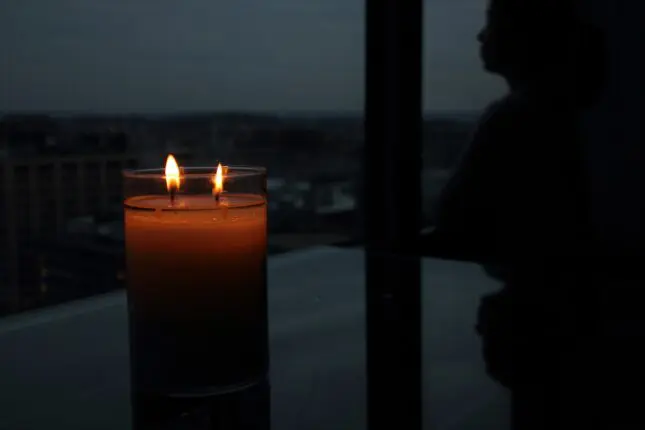
As we light candles to illuminate the darkness
This learned optimism that breeds survival
In our cells,
That permeates within our souls,
If we listen
Survival is the only way
Through peace and connection, not hatred rising.
While we don’t forget to dance.
***
Author’s Note: Portions of this essay draw from a recorded Holocaust survivor testimony given by a member of my extended family and held by the USC Shoah Foundation. Identifying details have been altered or withheld to respect privacy. I have not known Moshe or this branch of my family personally; some reflections are based on my interpretation of his testimony and on the broader context as it relates to family history. My intention is to honor his story, not to claim it as my own or make assumptions. Any reflections on emotional processes are offered with humility and care, and with deep respect for the private lives of any survivors and my family.

Andrea Yudell
Andrea Yudell, LICSW, LCSW-C, is a clinical social worker and psychotherapist in the DC Metro Area with 25 years of experience treating anxiety, trauma, chronic medical conditions, parenting stressors, and other life challenges. She integrates psychodynamic, cognitive-behavioral, and somatic approaches, including EMDR and somatic imagery, fostering clients’ sense of curiosity about themselves as a vehicle for insight, emotional regulation, and greater ease in daily life. In addition to her clinical work, she’s a founding member of the Jewish Social Work Consortium, a network of academics, clinicians, and advocates dedicated to promoting ethical standards, cultural competency, and awareness of dehumanizing narratives in the field.