

Enjoy the audio preview version of this article—perfect for listening on the go.
You don’t normally see memes and therapy in the same sentence. At first glance, memes seem disposable—we scroll through them, laugh at them, and forget about them. But this is exactly how their therapeutic value sneaks in: they turn complex emotional experiences into something instantly recognizable and shareable. A good meme instantly says, It’s not just you. It bypasses our left-brain thinking and becomes an emotional truth.
What can therapists do with memes? When shared in sessions, they can jump-start deep conversations, help clients name feelings they’d otherwise struggle to articulate, and reduce shame by shining a light on universal human challenges.
Recently, we showcased five memes your colleagues are sharing—and it was such a hit that we decided to share five more! Whether these simply bring a smile to your face or become the little tool you use to build rapport with a client or two, we hope you’ll enjoy more of these gentle reminders that healing doesn’t always have to be serious business.
Learning to Take Up Space
One of my favorite memes, which I sometimes share with clients, shows two pictures of a big, fluffy golden retriever and a tiny dog bed. In the first picture, the dog lies uncomfortably on the ground with its large, adorable head barely fitting on the small bed. In the other picture, the dog has positioned its large body on top of the bed like an elephant perched on a lily pad. Underneath, the caption reads, “Woman Accidentally Orders TINY Dog Bed, Dog Pretends Everything Is Fine.”
Some of us are a bit more like this sweet pup than we’d like to admit. We tend to plow ahead as if everything in our life is fine when really it isn’t. Maybe we show up for work sick when we should be home. Maybe we wear sunglasses to hide our teary eyes when we’ve been crying. Maybe we put on a happy face even though we’re mad at someone.

But let’s not mistake problems that are systemic in nature for personal problems. In a hypercapitalist society, workplaces convey to employees that they’re replaceable, creating the conditions for working while ill. Our culture confounds busyness with self-worth, treating exhaustion like a status symbol. And it judges sadness as weakness, making it nearly impossible for us to honor our pain and be honest about how we feel with all but a few trusted confidants. Our world has yet to value relationship education, so most of us have zero clue about what to do with our anger besides stuff it down or blow up. Our culture sets us up to act like the doggie in this meme, pretending like we can carry on when we clearly need to make a change.
Growing up, many of my clients learned to paper over their pain. When a family system is struggling with addiction, for example, homeostasis is maintained when everyone acts like they don’t see what they see, feel what they feel, and know what they know. Do that for long enough and you’ll even stop remembering how to identify what’s going on inside of you. The beautiful part about being alive is you can always come home to yourself. You can learn to recognize that you’re squishing your big, fuzzy body onto a teeny, tiny cushion. You can cultivate relationships that celebrate you when you speak up without fear and say, “Excuse me, I’ll be needing a larger bed to accommodate all this damn fluff!” You can come home to yourself.
What it Takes to “Calm Down”
Meme wisdom is far from perfect, but some memes can offer us spiritual or philosophical aphorisms, with a dose of humor to boot.
One of my all-time favorites is this one: “Never in the history of calming down has anyone ever calmed down by being told to calm down.” It’s resonated with me for a long time on a number of levels, and it’s a line I use in workshops and in therapy.
On the basic level, it reminds us that our work as therapists is much deeper than just conversation. If telling people to calm down worked to cure anxiety, we’d be the best therapists in the world—not to mention we’d put ourselves out of business in no time! It calls back to the Bob Newhart sketch where the psychiatrist tells their phobic patient to “Just stop it!” If only!

But it’s also a reminder to therapists, parents, caregivers, teachers, and even managers and bosses, of the limits of what they can and can’t do. As I like to say, people don’t “calm down” until they feel safe enough to calm down. And that comes down to the kind of holding environment we cultivate with our own compassionate, co-regulating presence. The more we regulate ourselves, the more our clients can safely attach to us and do the healing work that can only happen in relationship. It’s about cultivating what Deb Dana calls the “glimmers,” or people, places, and things that create safety, as opposed to the triggers that put our nervous system in defense mode.
In Buddhist psychology, we aren’t trying to make people change; the best we can do is create the conditions in which they’re most likely to change. And how do we do that? In part, it’s by changing ourselves, and then co-regulating nervous system change with our clients through mindfulness and other regulating practices.
If we want calm clients, we need to calm ourselves first. Of course, while we might sometimes wish we could do it, nobody wants a stressed-out therapist shouting at them to calm down, take a breath, and relax!
Finding the Right Fit
By Amy Clay
There’s a meme going around that was taken from a poignant scene from the movie Barbie. Weird Barbie, a breakout character with spiky hair whose legs are stuck in a permanent split position, presents Stereotypical Barbie with a choice: a high heel or a Birkenstock. The meme tags Weird Barbie as a therapist, which made me laugh hard—but with a pang, because it represents the unappealing choice I often feel like I’m offering clients as a relationship and trauma therapist.
It’s a visual metaphor for the struggle between choosing something idealized and seemingly picture-perfect (represented by a sleek, pink, uncomfortable high-heeled shoe) and the authentic experience of real life (represented by a crunchy, comfortable, and sometimes smelly Birk). When fitting, I’ve been sending this meme to colleagues who need a laugh and some validation for how hard the therapeutic process can be. For clients, it’s been a lighthearted way to explore the “fit of their shoe.”
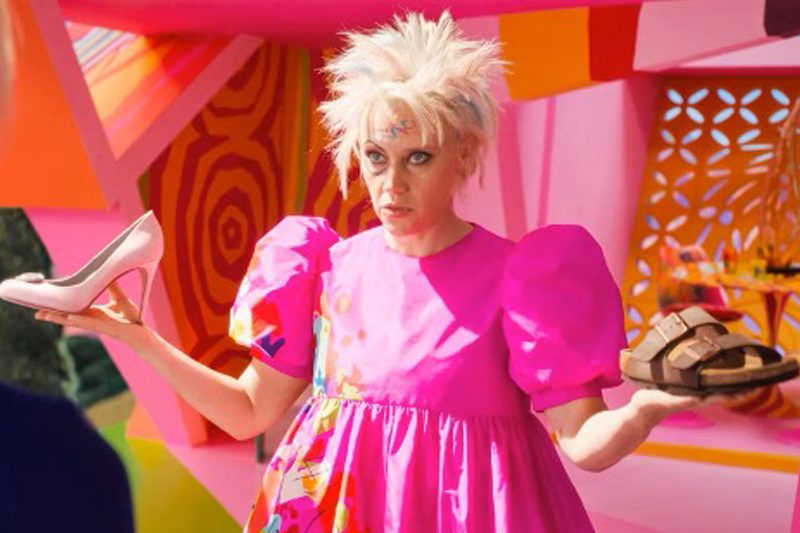
In particular, my clients who grapple with conforming to societal expectations, superficial standards, and perfectionism eventually realize these “high heels” can only be worn for so long. They can then choose to slip into a “Birkenstock,” realizing that only they can mold the shape of their lives. So this meme reflects a critical part of therapy—the tension between maintaining a polished façade (faking it) and choosing to recognize and embrace our authentic selves (working toward self-actualization).
When Weird Barbie encourages Stereotypical Barbie to consider her options, Barbie leans toward the high heel. Therapists and clients alike know that change is often daunting, unknown, and straight-up scary. Weird Barbie’s response to Stereotypical Barbie’s reluctance to choose the Birkenstock: “We’ll do a redo.” As a therapist, I know the work is continuing to offer clients a redo, allowing them to reclaim agency in the process and ultimately in their lives. Acknowledging that we all get stuck speaks to a truth therapists know well: growth sometimes requires a redo.
Helping clients recognize their power to choose is a fundamental part of therapy. The concept of a redo reinforces that we can change our circumstances and our past doesn’t have to define our future. How can we challenge ourselves to put down our heels and slip on our Birks? Maybe we want to try on a different shoe altogether, or even go barefoot! The key is making sure we’re grounded in whatever shoe we choose rather than forcing ourselves into a fit that isn’t right.
A Collective Laugh—and an Exhale
By Jackie Moore
Is it weird to choose a meme you created as your favorite meme? Maybe. But hear me out. In 2022, I began posting on social media. For so many of us, the world had begun to feel increasingly overwhelming and scary, and doomscrolling on social media was a gluttonous escape. At the time, I’d been a licensed therapist for seven years, specializing in play therapy with children and families, but I was far from a social media expert. Still, I was committed to creating a sense of community online that felt safe, supportive, and fun.
As I studied what resonated with my audience, I noticed something: the content I engaged with most wasn’t the polished educational posts. It was the funny stuff. Not just lighthearted humor, but deeply relatable, sometimes dark humor that captured the absurdities of our work as therapists.
One trend I loved featured therapists typing notes with on-screen text: “Born to write _______” vs. “Forced to write _______.” The format nailed one of the unique tensions in our work. We thrive on authenticity and vulnerability in session, but then we have to translate those moments into clinical jargon so the “insurance gods” will approve them. The comments (“relatable!” “I feel seen!” “Omg this is hilarious!”) made it clear. Humor was the fastest way to therapists’ hearts.
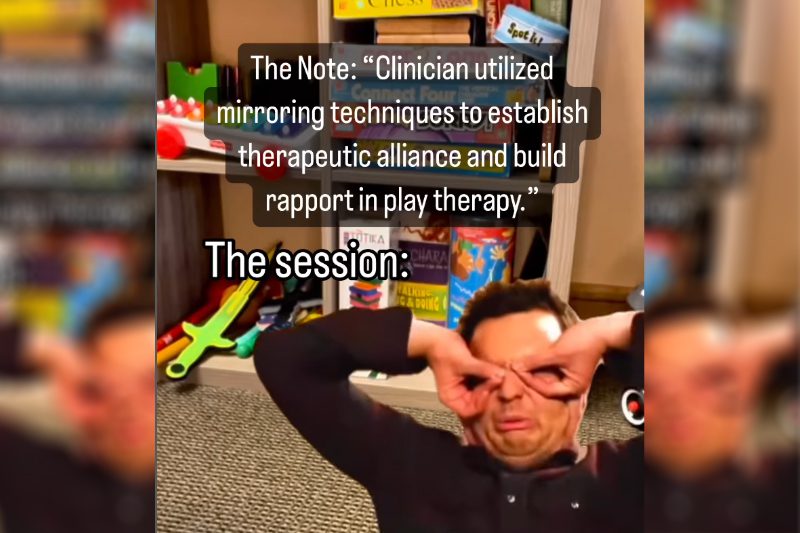
So I tested the theory. I made a meme that leaned right into the heart of play therapy. Anyone who’s worked with kids knows the willingness to be silly pays huge dividends in building connection. I chose a template from New Girl that I knew millennial therapists would recognize. I couldn’t stop laughing as I made it, but I wasn’t sure if anyone else would find it funny. The next day, I closed my eyes and hit post.
It took off. Within weeks, the meme had over a million views. But more than the numbers, it was the comments that told the story. Therapists tagged friends, filled the thread with laughing emojis, and even rewrote the “clinical language” to describe their own ridiculous sessions. One thing was abundantly clear: other therapists craved community and connection just as much as I did.
That moment crystallized something for me: memes aren’t just jokes, they’re connection points. They’re little reminders that behind all the charts, diagnoses, and heavy conversations, we’re humans doing deeply human work. Sometimes we need a collective laugh to exhale, to feel less alone, and to remember that our weirdness—the very thing we once worried might not be professional enough—is actually part of what makes us effective, resilient, and real.
The Joy—and Weight—of Wonder
Scrolling through Instagram after my two little humans finally crashed for the night this past holiday season, I found myself in full-on spiral mode. Questions rapidly popped through my head: Do I dare do Elf on the Shelf this year? How should I decorate? Are there any holiday events we have to take the kids to? And reindeer pancakes—Christmas Eve or Christmas Day? (Honestly, do they even care? It’s all about the whipped cream and sprinkles anyway.)
And then a post smacked me right in the feels: “Becoming an adult is realizing the magic behind Christmas was always just your mom.”
Cue the instant chuckle, followed by a slower, heavier realization that I am now the mom. I’m the mom lying awake, scrolling for recipes, hunting for Pinterest-perfect ideas, planning every detail so my kids can experience the magic I once took for granted.
As a therapist specializing in maternal mental health and a mom of two little ones who fully believe, this meme didn’t just feel relatable, it hit me with a surprising ache. Before I had kids, Christmas magic felt simpler. Now as a mom, I see all the quiet labor that goes on behind the scenes: the lists, the planning, the budgeting, the remembering, the emotional attunement.

Some days? I love it. I get to create the nostalgia my kids will one day treasure. I soak up the rituals of matching pajamas, Christmas pop playlists on repeat, and immersing myself in the smell of cookies and hot chocolate wafting throughout the house. There’s joy in being the keeper of wonder, in offering your kids a sense of safety, abundance, and magic in a world that often feels uncertain. It connects me to my children, and to generations of mothers who did the same, quietly, year after year.
And then there are the other days, the ones we don’t Instagram. When the magic feels heavy, the mental load relentless, the lists multiplying faster than hours in the day. When finances feel tight and the pressure to “make it special” starts to creep into my body as tension. When I’m tired both physically and emotionally from holding everyone else’s experience so carefully. On those days, this meme hits differently. It’s revealing. It reminds me that so much of the magic comes at a cost.
As a therapist, I tell myself that it’s okay for these experiences to exist at the same time. You can be grateful and overwhelmed. Honored and exhausted. Joyful and stretched thin. Loving the magic doesn’t erase the weight. Feeling the weight doesn’t mean you’re failing.
That post, playful as it was, quietly reminds us that the magic was made by a human who is capable of carrying joy and pressure. The magic matters—and it wouldn’t happen without you.

Alexandra Solomon
Alexandra H. Solomon, PhD, is internationally recognized as one of today’s most trusted voices in the world of relationships, and her framework of Relational Self-Awareness has reached millions of people around the globe. A couples therapist, speaker, author, professor, podcast host, retreat leader, and media personality, Dr. Solomon is passionate about translating cutting-edge research and clinical wisdom into practical tools people can use to bring awareness, curiosity, and authenticity to their relationships. She is a clinician educator and a frequent contributor to academic journals and research, and she translates her academic and therapeutic experience to the public through her popular and vibrant Instagram page, which has garnered over 200K followers. She is on faculty in the School of Education and Social Policy at Northwestern University and is a licensed clinical psychologist at The Family Institute at Northwestern University. Her hit podcast, Reimagining Love, has reached listeners across the globe and features high-profile guests from the worlds of therapy, academia, and pop culture. Her latest bestselling book is Love Every Day. You can visit her online at DrAlexandraSolomon.com and on Instagram at @dr.alexandra.solomon.

Christopher Willard
Christopher Willard, PsyD, is one of the world’s leading experts on mindfulness with young people, having trained thousands of professionals and young people on the practice and benefits of mindfulness. He is a psychologist and consultant based in Boston, working individually as well as consulting to schools, hospitals and other organizations. Additionally, he is the author of multiple books on psychology, child development, contemplative practice and more. Dr. Willard is the president of the Mindfulness in Education Network and serves on the board of directors at the Institute for Meditation and Psychotherapy. In addition to serving on the faculty of Harvard Medical School, Dr. Willard leads courses and workshops around the world and online. Dr. Willard is the co-author of The Mindfulness Skills Activity Book for Children (PESI, 2018), and the author of Child’s Mind (Parallax Press, 2010), Growing Up Mindful (Sounds True, 2016) and numerous others. He is also the co-author of the bestselling Growing Mindful (PESI, 2015), Growing Mindful 2nd Edition (PESI, 2019), Growing Mindful Spanish Edition (PESI, 2016), Growing Happy (PESI, 2016), Mindful Reminders (PESI, 2016), The Self-Compassion (PESI, 2016) and Anti-Burnout (PESI, 2017) card decks.

Amy Clay
Amy Clay, LPC, is Northern Virginia/ DC-based pending AASECT-certified sex therapist and Imago relationship therapist in private practice. She’s passionate about helping individuals and couples connect with themselves and each other on ways to create a more pleasurable, meaningful, and satisfying life. Contact: amycsunstone@gmail.com.

Jaclyn Moore
Jaclyn Moore, LCPC, RPT-S, is a registered play therapist supervisor with experience in schools, private agencies, and nonprofits, as well as the co-owner of Play Therapy House, Inc.

Christine Mark-Griffin
Christine Mark-Griffin, LCSW, RYT is a certified EMDR therapist and EMDRIA-approved consultant, as well as the owner of Spark All Wellness, a private practice specializing in EMDR therapy with children, EMDR consultation for clinicians, and trauma-informed trainings for professional organizations. She lectures at California State University, Monterey Bay.